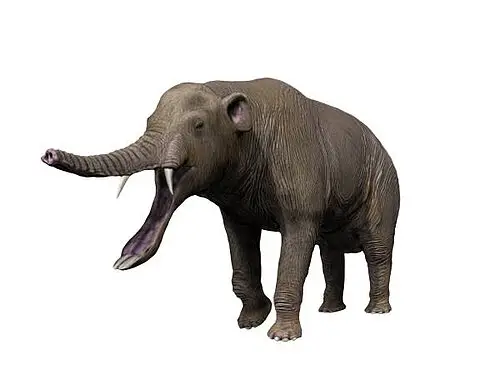
 🎨 Restoration
Restoration: Nobu Tamura email:nobu.tamura@yahoo.com http://spinops.blogspot.com/ http://paleoexhibit.blogspot.com/ · CC BY-SA 4.0 · Wikimedia Commons Source
Life restorations are artistic reconstructions based on fossil evidence; true coloration and soft-tissue details remain uncertain.
Platybelodon
Platybelodon grangeri (Platybelodon · Platybelodon)
Known only from fossils. The IUCN Red List assesses only species extant since 1500 CE, so fossil taxa are not assigned a category.
💡 Everyday Comparisons for Size, Mass & Speed
- 💡 Its flat, sharp-edged lower tusks resembled a sickle for cutting grass or the blade of a shovel (Comparison).
- 💡 Because skulls and lower jaws of males, females, and juveniles have all been found in the Linxia Basin, museum studies can compare how this species grew.
Reference standards: coach bus ~12 m, mid-size car ~4.9 m, compact car ~1 t, basketball hoop 3.05 m, credit card 8.56 cm.
📖 1. Overview
Platybelodon grangeri (genus Platybelodon) was an elephant relative that lived in Gansu Province and Inner Mongolia, China during the Middle Miocene, characterized by its flat, broad lower tusks. Many skulls and mandibles from juveniles to adults have been found in the Linxia Basin of Gansu Province, China.
🦴 2. Anatomy & Morphology
Its lower tusks were extremely flat and wide with a sharp cutting edge at the tip, and the front part of its lower jaw (the mandibular symphysis) was broad like a shovel.
🔍 3. Fossil Record & Paleoecology
Researchers reconstruct it as living in open grasslands, wrapping its flexible trunk around grass blades and slicing them off with the sharp edge of its lower tusks. This reconstruction comes from a research preprint under review.
🇰🇷 4. Connection to Korea
No direct record connecting this species to Korea has been found.
📚 Sources & References
- • Fossil taxon — the IUCN Red List assesses only species living or extinct since 1500
- • paleobiodb.org — basicTaxonInfo
- • wikidata.org — Q22105386
- • commons.wikimedia.org — File:Hohhot.inner mongolia museum.Platybelodon grangeri.2.jp
- • app.pan.pl — app20110009.pdf
- • elifesciences.org — 90908v2
- • Silhouette: PhyloPic — Scott Hartman · CC BY 3.0 (Related taxon silhouette — Gomphotherium angustidens)
Recorded dimensions are widely cited representative estimates from public literature and may vary by study or specimen.