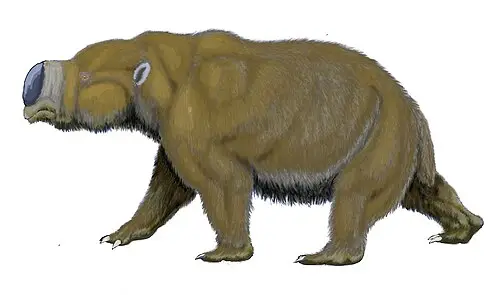
 🎨 Restoration
Restoration: Creator:Dmitry Bogdanov · CC BY 3.0 · Wikimedia Commons Source
Life restorations are artistic reconstructions based on fossil evidence; true coloration and soft-tissue details remain uncertain.
Diprotodon
Diprotodon optatum (Diprotodon · Diprotodon)
Known only from fossils. The IUCN Red List assesses only species extant since 1500 CE, so fossil taxa are not assigned a category.
💡 Everyday Comparisons for Size, Mass & Speed
- 💡 A body length of nearly 4 m is slightly shorter than a passenger car (about 4.5 m) (Comparison).
- 💡 The Australian Museum compares its maximum weight of 2.7 tons as lighter than a hippopotamus (up to 4.5 tons).
Reference standards: coach bus ~12 m, mid-size car ~4.9 m, compact car ~1 t, basketball hoop 3.05 m, credit card 8.56 cm.
Site-computed relative index from recorded values; not a formal scientific metric.
📖 1. Overview
Diprotodon optatum (genus Diprotodon) is the largest marsupial known to date and was a herbivorous animal that lived in Australia. It disappeared about 20,000 and 5,000 years ago.
🦴 2. Anatomy & Morphology
It was a heavily built, big-bellied four-legged animal. Its skull was large but light, with many air spaces inside.
🔍 3. Fossil Record & Paleoecology
It lived alongside the first Indigenous peoples to arrive in Australia for thousands of years. In the middle of Lake Callabonna in South Australia, hundreds of individuals were found trapped in mud as the lake bed dried.
🇰🇷 4. Connection to Korea
No direct record connecting this species to Korea has been found.
📚 Sources & References
- • Fossil taxon — the IUCN Red List assesses only species living or extinct since 1500
- • paleobiodb.org — basicTaxonInfo
- • wikidata.org — Q3708910
- • commons.wikimedia.org — File:Diprotodon optatum (2).jpg
- • australian.museum — diprotodon-optatum
- • Silhouette: PhyloPic — Steven Traver · CC0 1.0
Recorded dimensions are widely cited representative estimates from public literature and may vary by study or specimen.