 🎨 Restoration
Restoration: Gary Todd · CC0 · Wikimedia Commons Source
Life restorations are artistic reconstructions based on fossil evidence; true coloration and soft-tissue details remain uncertain.
Palaeoloxodon
Palaeoloxodon naumanni (Palaeoloxodon · ナウマンゾウ)
Known only from fossils. The IUCN Red List assesses only species extant since 1500 CE, so fossil taxa are not assigned a category.
💡 Everyday Comparisons for Size, Mass & Speed
- 💡 A shoulder height of about 2.8 m is taller than the ceiling height of a typical apartment room (about 2.3–2.4 m) (Comparison).
- 💡 The Nojiri-ko Naumann Elephant Museum in Nagano Prefecture has a hands-on corner where visitors can touch fossilized cheek teeth (molars).
Reference standards: coach bus ~12 m, mid-size car ~4.9 m, compact car ~1 t, basketball hoop 3.05 m, credit card 8.56 cm.
📖 1. Overview
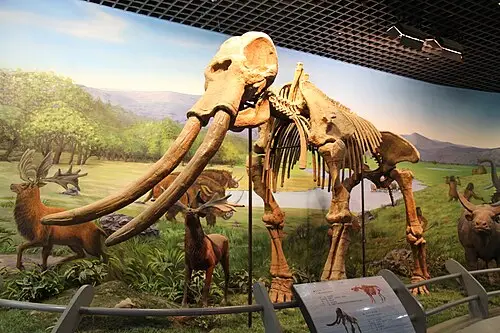
Palaeoloxodon naumanni (Naumann's elephant) was an elephant that lived in Japan from about 350,000 to twenty-eight thousand years ago. Because many fossils have been found at Lake Nojiri in Nagano Prefecture, it is introduced as an iconic animal of Ice Age Japan.
🦴 2. Anatomy & Morphology
A life-sized model reconstructed from Lake Nojiri fossils stands about 2.8 m tall at the shoulder and measures about 6 m from the tip of the tusks to the tail.
🔍 3. Fossil Record & Paleoecology
Because stone and bone tools have been found alongside its fossils at Lake Nojiri, the site is regarded as a hunting ground for Naumann's elephant, where people made and used bone tools from about fifty-four thousand to thirty-eight thousand years ago. Excavations have continued with public participation since 1962.
🇰🇷 4. Connection to Korea
No direct record connecting this species to Korea has been found.
📚 Sources & References
- • Fossil taxon — the IUCN Red List assesses only species living or extinct since 1500
- • paleobiodb.org — basicTaxonInfo
- • wikidata.org — Q1593261
- • commons.wikimedia.org — File:Palaeoloxodon naumanni Hokkaido Museum collection.jpg
- • nojiriko-museum.com
- • Silhouette: PhyloPic — Asier Larramendi · CC BY 4.0 (Congeneric silhouette — Palaeoloxodon falconeri)
Recorded dimensions are widely cited representative estimates from public literature and may vary by study or specimen.