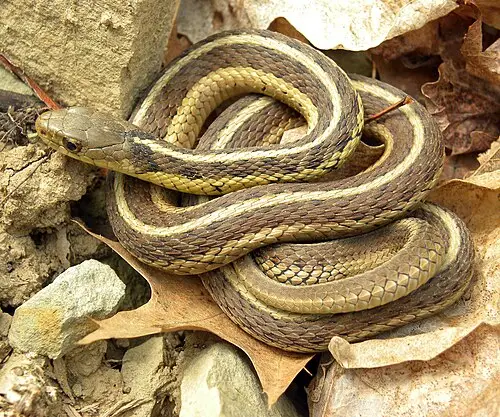
 📸 Photo
Photo: Wilson44691 · Public domain · Wikimedia Commons Source
Common Garter Snake
Thamnophis sirtalis (Common Garter Snake · Common Garter Snake)
💡 Everyday Comparisons for Size, Mass & Speed
- 💡 An average weight of 150 g is about the weight of three chicken eggs (Comparison).
- 💡 Animal Diversity Web notes that the Common Garter Snake is a welcome visitor for gardeners because it reduces insect and mollusk pests, and that it tames easily and is also kept as a pet.
Reference standards: coach bus ~12 m, mid-size car ~4.9 m, compact car ~1 t, basketball hoop 3.05 m, credit card 8.56 cm.
Site-computed relative index from recorded values; not a formal scientific metric.
📖 1. Overview
The Common Garter Snake is a non-venomous snake widespread across North America, living in moist waterside grasslands as well as bushes in suburbs and cities.
🦴 2. Anatomy & Morphology
It usually has three light stripes running along a black, brown, gray, or olive background. Some individuals have faint or absent stripes, and the head is wider than the neck and uniformly dark.
🔍 3. Ecology & Behavior
It eats earthworms, amphibians, leeches, slugs, snails, insects, crayfish, and small fish, and is unharmed by the skin toxins of toads. Active by day, it hibernates from late month 10 to month 3, gathering in large numbers at overwintering sites.
🇰🇷 4. Connection to Korea
No direct record connecting this species to Korea has been found.
📚 Sources & References
- • IUCN Red List LC (2015) — https://www.iucnredlist.org/species/62240/68308267
- • IUCN Red List category LC — latest assessment at iucnredlist.org
- • catalogueoflife.org — 563LK
- • iucnredlist.org — 68308267
- • wikidata.org — Q911786
- • commons.wikimedia.org — File:Thamnophis sirtalis sirtalis Wooster.jpg
- • animaldiversity.org — Thamnophis sirtalis
- • Silhouette: PhyloPic — Alex Slavenko · CC0 1.0 (Related taxon silhouette — Elaphe quatuorlineata)
Recorded dimensions are widely cited representative estimates from public literature and may vary by study or specimen.