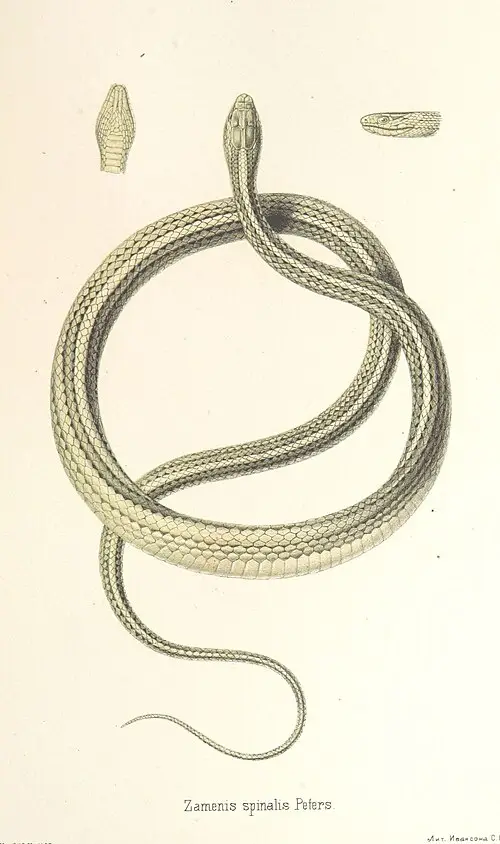
 📸 Photo
Photo: Nikolay Przhevalsky · Public domain · Wikimedia Commons Source
Slender Racer
Orientocoluber spinalis (Slender Racer · Slender Racer)
💡 Everyday Comparisons for Size, Mass & Speed
- 💡 An egg length of 38 mm is similar to the length of a quail egg (about 3.5 cm) (Comparison).
- 💡 It is observed near land worked by people, such as rice paddy banks, stone piles along rivers, and fallow fields (National List of Species of Korea).
Reference standards: coach bus ~12 m, mid-size car ~4.9 m, compact car ~1 t, basketball hoop 3.05 m, credit card 8.56 cm.
📖 1. Overview
The Slender Racer is a thin, agile snake that can be seen in lowland grasslands, farmland, and along rivers throughout Korea.
🦴 2. Anatomy & Morphology
Its back is light greenish brown with a yellow stripe running down the center from the front tip of the frontal scale to the tip of the tail, bordered by black on both sides. The belly is yellow with black spots along the outer edges, and compared to other snakes it has fewer vertebrae and well-developed eyesight.
🔍 3. Ecology & Behavior
It preys on frogs, insects, and grass lizards, and is known as the fastest snake in Korea. Around month 7 it lays about 10 eggs measuring roughly 38 mm × 11 mm, and it hibernates starting in month 10.
🇰🇷 4. Connection to Korea
It is listed as 'Silbaem (Korean name)' in the National List of Species of Korea and is distributed nationwide in Korea.
📚 Sources & References
- • IUCN Red List LC (2021) — https://www.iucnredlist.org/species/192006/2026945
- • IUCN Red List category LC — latest assessment at iucnredlist.org
- • catalogueoflife.org — 755KN
- • iucnredlist.org — 2026945
- • 국가생물종목록(국립생물자원관) ktsn 120000059491 — https://species.nibr.go.kr/home/mainHome.do?cont_link=009&subMenu=009002&contCd=009002&ktsn=120000059491
- • wikidata.org — Q19917331
- • commons.wikimedia.org — File:Zamenis spinalis.jpg
- • species.nibr.go.kr — mainHome.do
- • Silhouette: PhyloPic — Alex Slavenko · CC0 1.0 (Related taxon silhouette — Elaphe quatuorlineata)
Recorded dimensions are widely cited representative estimates from public literature and may vary by study or specimen.