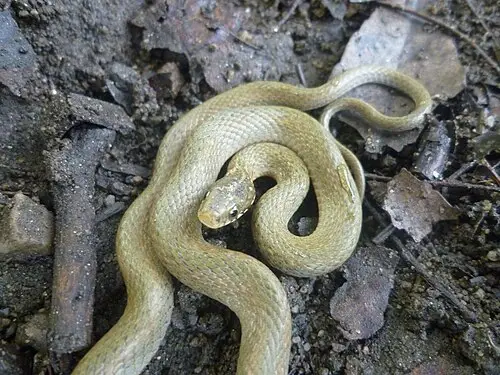
 📸 Photo
Photo: W.CC · CC BY-SA 3.0 · Wikimedia Commons Source
Japanese Keelback
Hebius vibakari (Japanese Keelback · ヒバカリ)
💡 Everyday Comparisons for Size, Mass & Speed
- 💡 Its maximum length of 60 cm equals two 30 cm rulers placed end to end (Comparison).
- 💡 Kyoto Prefecture notes that as rice paddies shrink and undergo land consolidation, both the habitat of this snake and its frog and tadpole prey are declining, making it important to conserve waterside and paddy environments.
Reference standards: coach bus ~12 m, mid-size car ~4.9 m, compact car ~1 t, basketball hoop 3.05 m, credit card 8.56 cm.
📖 1. Overview
The Japanese Keelback (Japanese name Hibakari) is a small, non-venomous snake; the Japanese subspecies lives around watersides and rice paddies across Honshu, Shikoku, and Kyushu.
🦴 2. Anatomy & Morphology
Its back is a uniform brown with yellowish-white markings on the sides of the neck, and rows of small black dots run along both sides of the belly scales.
🔍 3. Ecology & Behavior
Active at dawn and dusk, it favors watersides and eats earthworms, small fish, tadpoles, and frogs. Kyoto Prefecture considers its numbers to have declined as rice paddies have shrunk and been consolidated, reducing its habitat and prey.
🇰🇷 4. Connection to Korea
It is a species distributed in Korea, listed as "Daeryuk-yuhyeolmogi" (Korean name) in the National List of Species of Korea.
📚 Sources & References
- • IUCN Red List LC (2021) — https://www.iucnredlist.org/species/192162/2049133
- • IUCN Red List category LC — latest assessment at iucnredlist.org
- • catalogueoflife.org — 3JY8Y
- • iucnredlist.org — 2049133
- • 국가생물종목록(국립생물자원관) ktsn 120000059479 — https://species.nibr.go.kr/home/mainHome.do?cont_link=009&subMenu=009002&contCd=009002&ktsn=120000059479
- • wikidata.org — Q30004730
- • commons.wikimedia.org — File:Vibakari2.jpg
- • pref.kyoto.jp — craw0010.html
- • species.nibr.go.kr — mainHome.do
- • Silhouette: PhyloPic — Alex Slavenko · CC0 1.0 (Related taxon silhouette — Elaphe quatuorlineata)
Recorded dimensions are widely cited representative estimates from public literature and may vary by study or specimen.