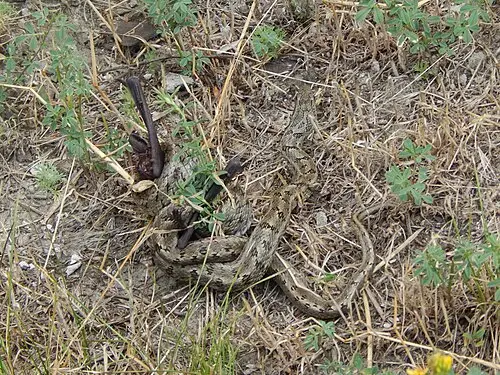
 📸 Photo
Photo: Моховинка · CC BY 4.0 · Wikimedia Commons Source
Steppes Ratsnake
Elaphe dione (Steppes Ratsnake · サラサナメラ)
💡 Everyday Comparisons for Size, Mass & Speed
- 💡 A weight of 205 g is roughly the weight of three or four chicken eggs (Comparison).
- 💡 In a study at a crane park in China, even with 100–500 tourists passing by daily, the snakes gathered to live using the undersides of human-made structures as shelter.
Reference standards: coach bus ~12 m, mid-size car ~4.9 m, compact car ~1 t, basketball hoop 3.05 m, credit card 8.56 cm.
Site-computed relative index from recorded values; not a formal scientific metric.
📖 1. Overview
The Steppes Ratsnake is a snake widely distributed from eastern Europe through Russia, Central Asia, the Korean Peninsula, and northern China.
🦴 2. Anatomy & Morphology
Among 16 radio-tracked individuals in a Chinese study, females averaged about 205 g and males about 134 g, making females heavier.
🔍 3. Ecology & Behavior
Active by day, it moved most between 9–11 a.m. and 2–4 p.m. In a crane park in China, it favored spaces beneath human-made structures for shelter and warming up, and nearby rodents were considered its likely prey.
🇰🇷 4. Connection to Korea
It is a native Korean snake listed as "Nurukbaem" (Korean name) in the National List of Species of Korea, and there is also a 2011 record of a two-headed Steppes Ratsnake found in the wild in Korea.
📚 Sources & References
- • IUCN Red List LC (2017) — https://www.iucnredlist.org/species/157275/747623
- • IUCN Red List category LC — latest assessment at iucnredlist.org
- • catalogueoflife.org — 38YKZ
- • iucnredlist.org — 747623
- • 국가생물종목록(국립생물자원관) ktsn 120000059484 — https://species.nibr.go.kr/home/mainHome.do?cont_link=009&subMenu=009002&contCd=009002&ktsn=120000059484
- • wikidata.org — Q533192
- • pmc.ncbi.nlm.nih.gov — PMC8991271
- • reptile-database.reptarium.cz — species
- • species.nibr.go.kr — general-search
- • commons.ln.edu.hk — 5041
- • Silhouette: PhyloPic — Alex Slavenko · CC0 1.0 (Congeneric silhouette — Elaphe quatuorlineata)
Recorded dimensions are widely cited representative estimates from public literature and may vary by study or specimen.