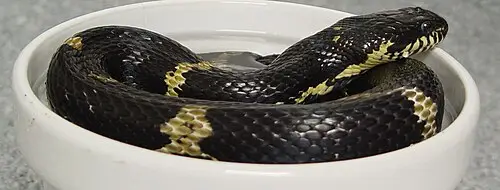
 📸 Photo
Photo: Rvanbeusichem · CC BY-SA 3.0 · Wikimedia Commons Source
Amur Ratsnake
Elaphe schrenckii (Amur Ratsnake · チョウセンナメラ)
🇰🇷 Class II endangered wildlife (Korea)
💡 Everyday Comparisons for Size, Mass & Speed
- 💡 In Chiaksan National Park, 11 captive-bred one- to two-year-old Amur Ratsnakes were fitted with transmitters, released, and tracked for a month each in August–September 2010 and June–July 2011—one method of restoring a declining species.
- 💡 A genome paper noted that habitat fragmentation and illegal capture and trade have driven its decline; refraining from catching conspicuous large snakes is the starting point for conservation.
Reference standards: coach bus ~12 m, mid-size car ~4.9 m, compact car ~1 t, basketball hoop 3.05 m, credit card 8.56 cm.
📖 1. Overview
The Amur Ratsnake is a large non-venomous snake living on the Korean Peninsula, in the Russian Far East and Amur River basin, and in northern China; in Korea it is an endangered species.
🦴 2. Anatomy & Morphology
It is a large, non-venomous snake. A single reference specimen (lectotype) listed in the Reptile Database measures 1,950 mm in length, and no larger representative figure has yet been confirmed.
🔍 3. Ecology & Behavior
It eats small mammals, birds, and frogs, lays eggs, and is semi-arboreal. When captive-bred juveniles were released and tracked on Chiaksan, they moved about 17 m per day and were found mainly in underground and ground-level shelters.
🇰🇷 4. Connection to Korea
In Korea, it is designated as Class II endangered wildlife (Korea). Studies releasing captive-bred individuals into the wild and tracking their movements have been conducted at places such as Chiaksan National Park.
📚 Sources & References
- • IUCN Red List LC (2021) — https://www.iucnredlist.org/species/192165/2049795
- • 멸종위기 야생생물 Ⅱ급 — 국가생물종목록(국립생물자원관) ktsn 120000059485 — https://species.nibr.go.kr/home/mainHome.do?cont_link=009&subMenu=009002&contCd=009002&ktsn=120000059485
- • IUCN Red List category LC — latest assessment at iucnredlist.org
- • Korean protection status: Class II endangered wildlife (Korea)
- • catalogueoflife.org — 38YMM
- • iucnredlist.org — 2049795
- • 국가생물종목록(국립생물자원관) ktsn 120000059485 — https://species.nibr.go.kr/home/mainHome.do?cont_link=009&subMenu=009002&contCd=009002&ktsn=120000059485
- • wikidata.org — Q955444
- • commons.wikimedia.org — File:Schrenki.JPG
- • reptile-database.reptarium.cz — species
- • pmc.ncbi.nlm.nih.gov — PMC12089936
- • accesson.kr — 6824
- • species.nibr.go.kr — general-search
- • Silhouette: PhyloPic — Alex Slavenko · CC0 1.0 (Congeneric silhouette — Elaphe quatuorlineata)
Recorded dimensions are widely cited representative estimates from public literature and may vary by study or specimen.