 📸 Photo
Photo: Serstef · CC BY-SA 4.0 · Wikimedia Commons Source
Frog-eating Rat Snake
Oocatochus rufodorsatus (Frog-eating Rat Snake · Frog-eating Rat Snake)
💡 Everyday Comparisons for Size, Mass & Speed
- 💡 Because it preys on Black-spotted Pond Frogs and Japanese Treefrogs near paddy banks and canals, it is one of the water snakes most commonly seen in rural areas with rice paddies (National List of Species of Korea, ecology).
- 💡 The National List of Species of Korea records it across the mainland and west coast islands except Jeju Island, making it a snake that can be encountered almost anywhere in the country (domestic distribution).
Reference standards: coach bus ~12 m, mid-size car ~4.9 m, compact car ~1 t, basketball hoop 3.05 m, credit card 8.56 cm.
📖 1. Overview
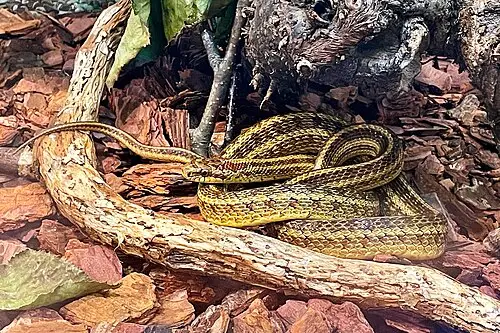
The Frog-eating Rat Snake is a non-venomous snake that lives near water such as rice paddy banks, irrigation canals, and reservoirs, and can be seen throughout Korea except Jeju Island.
🦴 2. Anatomy & Morphology
Its head is relatively long and slender with a wide snout. The back is light brown, reddish brown, or yellowish brown with an orange-yellow stripe down the center, and the head bears a ∧-shaped black blotch.
🔍 3. Ecology & Behavior
It mainly preys on frogs such as the Black-spotted Pond Frog and Japanese Treefrog, and also eats small rodents around rice paddies. It mates around month 5 and gives birth to 11–16 young around month 8; the young hatch inside the egg and break through the egg membrane immediately upon birth.
🇰🇷 4. Connection to Korea
It is listed as 'Mujachi (Korean name)' in the National List of Species of Korea and is distributed nationwide except Jeju Island, usually waking from hibernation in month 4 and entering hibernation around month 10.
📚 Sources & References
- • IUCN Red List LC (2021) — https://www.iucnredlist.org/species/177427/1485422
- • IUCN Red List category LC — latest assessment at iucnredlist.org
- • catalogueoflife.org — 49RQV
- • iucnredlist.org — 1485422
- • 국가생물종목록(국립생물자원관) ktsn 120000059487 — https://species.nibr.go.kr/home/mainHome.do?cont_link=009&subMenu=009002&contCd=009002&ktsn=120000059487
- • wikidata.org — Q2710734
- • species.nibr.go.kr — mainHome.do
- • Silhouette: PhyloPic — Alex Slavenko · CC0 1.0 (Related taxon silhouette — Elaphe quatuorlineata)
Recorded dimensions are widely cited representative estimates from public literature and may vary by study or specimen.