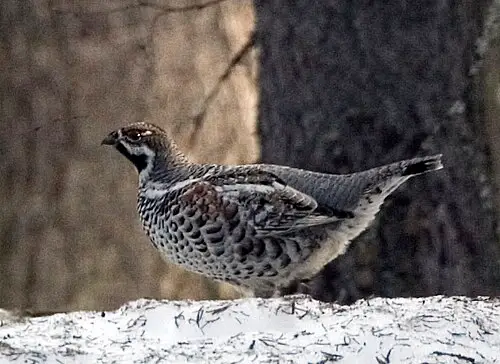
 📸 Photo
Photo: kallerna · Public domain · Wikimedia Commons Source
Hazel Grouse
Tetrastes bonasia (Hazel Grouse · エゾライチョウ)
💡 Everyday Comparisons for Size, Mass & Speed
- 💡 Its body length of 36 cm is slightly longer than the long side of an A4 sheet of paper (about 30 cm) (Comparison).
- 💡 Living in dense forests across the Korean Peninsula except Jeju Island and Ulleungdo, it can be encountered on the forest floor when hiking in the mountains (National List of Species of Korea domestic distribution).
- 💡 When approached by a person, it characteristically bursts into flight with a whirr of wings and perches on a tree branch (National List of Species of Korea).
Reference standards: coach bus ~12 m, mid-size car ~4.9 m, compact car ~1 t, basketball hoop 3.05 m, credit card 8.56 cm.
📖 1. Overview
The Hazel Grouse is a bird in the pheasant family living in northern Eurasia, and in Korea it is described as a common resident bird of dense forests. It walks on the ground to forage.
🦴 2. Anatomy & Morphology
Its body length is 36 cm, and its entire body is mottled brown. Males and females look generally similar, but males have a black patch from the chin to the throat.
🔍 3. Ecology & Behavior
It breeds on the ground beneath shrub roots under fallen trees in the forest, with a laying season from May to June. It walks on the ground in search of food and, when startled, flushes with a whirr of wings to perch on a tree branch.
🇰🇷 4. Connection to Korea
In the National List of Species of Korea, it is listed as a resident bird inhabiting the entire Korean Peninsula except Jeju Island and Ulleungdo.
📚 Sources & References
- • IUCN Red List LC (2024) — https://www.iucnredlist.org/species/22679494/264573522
- • IUCN Red List category LC — latest assessment at iucnredlist.org
- • doi.org — avilist.v2026
- • iucnredlist.org — 264573522
- • 국가생물종목록(국립생물자원관) ktsn 120000001403 — https://species.nibr.go.kr/home/mainHome.do?cont_link=009&subMenu=009002&contCd=009002&ktsn=120000001403
- • wikidata.org — Q182761
- • commons.wikimedia.org — File:Tetrastes bonasia.jpg
- • species.nibr.go.kr — mainHome.do
- • Silhouette: PhyloPic — author not recorded · Public Domain Mark 1.0 (Related taxon silhouette — Arborophila hyperythra)
Recorded dimensions are widely cited representative estimates from public literature and may vary by study or specimen.