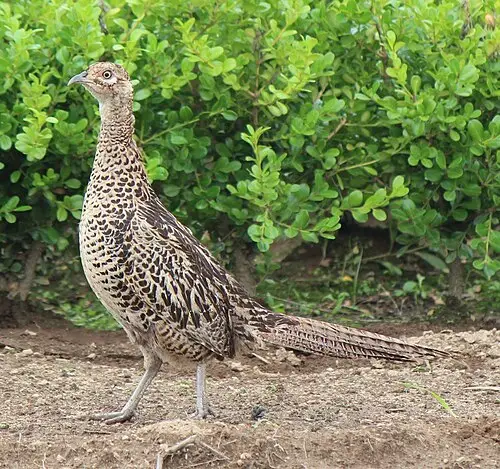
 📸 Photo
Photo: Alpsdake · CC BY-SA 3.0 · Wikimedia Commons Source
Green Pheasant
Phasianus versicolor (Green Pheasant · キジ)
💡 Everyday Comparisons for Size, Mass & Speed
- 💡 The maximum male weight of 1,387 g is slightly lighter than a 1.5 L bottle of water, and the maximum male tail length of 42.5 cm is one and a half 30 cm rulers long (Comparison).
- 💡 Appearing in the Japanese folktale 'Momotaro,' it is very familiar to people in Japan.
- 💡 It is known as a bird living close to people in farmlands, riverside meadows, and bamboo groves.
Reference standards: coach bus ~12 m, mid-size car ~4.9 m, compact car ~1 t, basketball hoop 3.05 m, credit card 8.56 cm.
Site-computed relative index from recorded values; not a formal scientific metric.
📖 1. Overview
The Green Pheasant is a pheasant living in Japan that became Japan's national bird in 1947 on the recommendation of the Ornithological Society of Japan. In Japan it is often treated as a subspecies of the Common Pheasant, whereas internationally it is often treated as a distinct species.
🦴 2. Anatomy & Morphology
Males have a dark green metallic gloss on a black breast, and the red bare skin around the eyes swells greatly during the breeding season. Females are pale buff with a reddish-rust tinge and black U-shaped bars, and the male's tail (270–425 mm) is longer than the female's (202–275 mm).
🔍 3. Ecology & Behavior
Walking on the ground, it eats grasses, berries, grain, grasshoppers, spiders, and snails alike. During the spring breeding season, males give a 'ken-ken' call and drum their wings; females nest in a shallow scrape on the ground, laying 6–12 eggs per clutch that hatch in 23–25 days.
🇰🇷 4. Connection to Korea
Japanese sources distinguish the pheasant introduced and spread in Japan as the subspecies 'Koraikiji,' whose range includes Tsushima.
📚 Sources & References
- • IUCN Red List LC (2025) — https://www.iucnredlist.org/species/22732650/280936637
- • IUCN Red List category LC — latest assessment at iucnredlist.org
- • doi.org — avilist.v2026
- • iucnredlist.org — 280936637
- • wikidata.org — Q425900
- • commons.wikimedia.org — File:Phasianus versicolor female.JPG
- • bird-research.jp — kiji2.pdf
- • Silhouette: PhyloPic — Mattia Menchetti · CC0 1.0 (Congeneric silhouette — Phasianus colchicus)
Recorded dimensions are widely cited representative estimates from public literature and may vary by study or specimen.