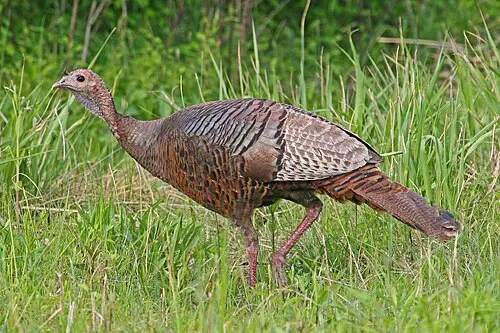
 📸 Photo
Photo: Judy Gallagher · CC BY 2.0 · Wikimedia Commons Source
Wild Turkey
Meleagris gallopavo (Wild Turkey · シチメンチョウ)
💡 Everyday Comparisons for Size, Mass & Speed
- 💡 Its maximum weight of 11 kg is slightly heavier than a 10 kg bag of rice, and a male's standing height of 1.2 m is about the height of a lower-grade elementary school child.
- 💡 Its recorded flight speed of 88.5 km/h is close to a highway speed limit (100 km/h).
- 💡 It is one of the most popular game birds in the United States, and revenue raised from turkey hunting is used for conservation projects such as habitat improvement (ADW, Economic Importance for Humans: Positive).
Reference standards: coach bus ~12 m, mid-size car ~4.9 m, compact car ~1 t, basketball hoop 3.05 m, credit card 8.56 cm.
Site-computed relative index from recorded values; not a formal scientific metric.
📖 1. Overview
The Wild Turkey is a large ground-dwelling bird with long legs, a long neck, and a fan-shaped tail, and is the heaviest member of the order Galliformes. It forages on the ground by day and roosts in trees at night.
🦴 2. Anatomy & Morphology
Males have dark, iridescent plumage with a red wattle on the throat and a blackish breast tuft, and their heads turn red, blue, or white depending on the season. Their leg spurs grow up to 3.2 cm long, while females are smaller and more subtly colored.
🔍 3. Ecology & Behavior
It is omnivorous, eating mostly plant matter such as acorns, nuts, seeds, buds, and leaves while ground-dwelling insects and salamanders make up about 10% of its diet. A swift runner and fast flier, the male attracts females by gobbling and fanning his tail.
🇰🇷 4. Connection to Korea
No direct record connecting this species to Korea has been found.
📚 Sources & References
- • IUCN Red List LC (2018) — https://www.iucnredlist.org/species/22679525/132051953
- • IUCN Red List category LC — latest assessment at iucnredlist.org
- • doi.org — avilist.v2026
- • iucnredlist.org — 132051953
- • wikidata.org — Q26844
- • commons.wikimedia.org — File:Wild Turkey (female) - Meleagris gallopavo, Occoquan Ba
- • nationalzoo.si.edu — wild-turkey
- • animaldiversity.org — Meleagris gallopavo
- • Silhouette: PhyloPic — author not recorded · CC0 1.0
Recorded dimensions are widely cited representative estimates from public literature and may vary by study or specimen.