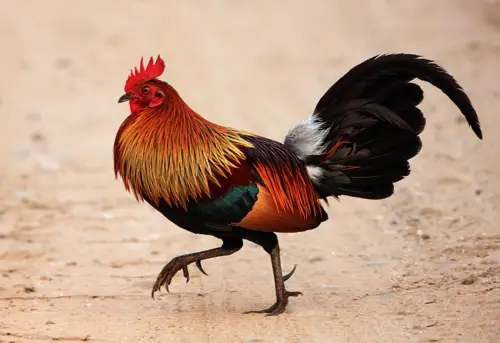
 📸 Photo
Photo: Subramanya C K · CC BY-SA 3.0 · Wikimedia Commons Source
Red Junglefowl
Gallus gallus (Red Junglefowl · セキショクヤケイ)
💡 Everyday Comparisons for Size, Mass & Speed
- 💡 Its average weight of 2.58 kg is about one-fourth (1/4) of a 10 kg bag of rice (Comparison).
- 💡 Chickens are raised mainly for eggs and meat, and their feathers have been used to stuff pillows and bedding (ADW "Economic Importance for Humans: Positive").
- 💡 Flocks have a social hierarchy called a "pecking order," and chicks begin learning this order when they are about a week old (ADW behavior account).
Reference standards: coach bus ~12 m, mid-size car ~4.9 m, compact car ~1 t, basketball hoop 3.05 m, credit card 8.56 cm.
Site-computed relative index from recorded values; not a formal scientific metric.
📖 1. Overview
The Red Junglefowl is the wild relative of the domestic chicken, living in dense forests and scrub and coming out to open areas in the morning and evening to forage.
🦴 2. Anatomy & Morphology
Its plumage is a mix of gold, red, brown, dark maroon, and orange with a touch of metallic green gloss, ear-shaped white patches on both sides of the head, and grayish legs. Roosters are more colorful than domestic chickens and have tails about 28 cm long.
🔍 3. Ecology & Behavior
It is an omnivore that eats corn, soybeans, grains, and grass as well as earthworms and insects. A strict pecking order allows a single dominant rooster to rule the flock while hens feed under his protection. Eggs hatch after 21 days of incubation.
🇰🇷 4. Connection to Korea
No direct record connecting this species to Korea has been found.
📚 Sources & References
- • IUCN Red List LC (2024) — https://www.iucnredlist.org/species/22679199/263732457
- • IUCN Red List category LC — latest assessment at iucnredlist.org
- • doi.org — avilist.v2026
- • iucnredlist.org — 263732457
- • wikidata.org — Q184774
- • commons.wikimedia.org — File:Red jungle fowl.png
- • animaldiversity.org — Gallus gallus
- • Silhouette: PhyloPic — Edwin Price · CC BY 4.0
Recorded dimensions are widely cited representative estimates from public literature and may vary by study or specimen.