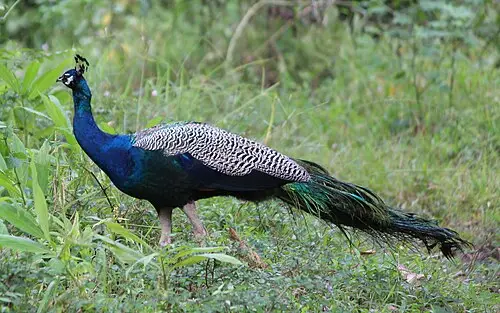
 📸 Photo
Photo: Praveenp · CC BY-SA 4.0 · Wikimedia Commons Source
Indian Peafowl
Pavo cristatus (Indian Peafowl · インドクジャク)
💡 Everyday Comparisons for Size, Mass & Speed
- 💡 Its maximum weight of 6 kg is slightly more than half of a 10 kg bag of rice, and its wingspan of 1.6 m is about the height of an adult human (Comparison).
- 💡 So named 'killer of snakes' in Sanskrit, it is valued in India because it eats even young cobras (ADW food habits account).
- 💡 Its train feathers were used to decorate helmets and hats in the Middle Ages and are now also used in flower arrangements (ADW positive impacts account).
Reference standards: coach bus ~12 m, mid-size car ~4.9 m, compact car ~1 t, basketball hoop 3.05 m, credit card 8.56 cm.
Site-computed relative index from recorded values; not a formal scientific metric.
📖 1. Overview
The Indian Peafowl is a large pheasant-family bird best known for its extravagant train (long ornamental feathers) and plumage. When tail and wingspan are included, it ranks among the largest flying birds.
🦴 2. Anatomy & Morphology
It weighs 2.7–6 kg and has a wingspan of 1.4–1.6 m. Its legs are long and strong, both sexes have spurs about 2.5 cm long, and females are brown, gray, and cream-colored. Males have a long train with many eyespots.
🔍 3. Ecology & Behavior
It is an omnivore that eats insects, earthworms, lizards, frogs, snakes, flower buds, petals, grain, grass, and bamboo shoots, and especially likes termites. A male defends a territory and gathers a harem of up to six females, and males with more eyespots have greater mating success.
🇰🇷 4. Connection to Korea
No direct record connecting this species to Korea has been found.
📚 Sources & References
- • IUCN Red List LC (2025) — https://www.iucnredlist.org/species/22679435/154429562
- • IUCN Red List category LC — latest assessment at iucnredlist.org
- • doi.org — avilist.v2026
- • iucnredlist.org — 154429562
- • wikidata.org — Q61865
- • commons.wikimedia.org — File:Indian Peacock in Tholpetty Wildlife Sanctuary 01.JPG
- • animaldiversity.org — Pavo cristatus
- • Silhouette: PhyloPic — author not recorded · CC0 1.0 (Congeneric silhouette — Pavo muticus)
Recorded dimensions are widely cited representative estimates from public literature and may vary by study or specimen.