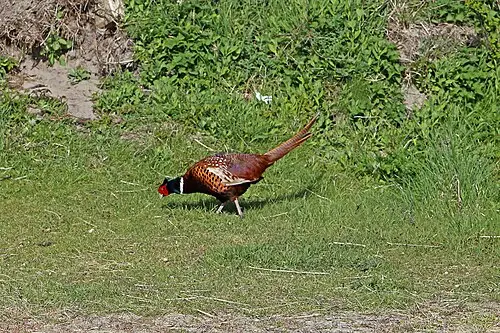
 📸 Photo
Photo: W. Bulach · CC BY-SA 4.0 · Wikimedia Commons Source
Common Pheasant
Phasianus colchicus (Common Pheasant · コウライキジ)
💡 Everyday Comparisons for Size, Mass & Speed
- 💡 It appears in Korean proverbs such as 'eating the pheasant and its egg too' and 'a chicken instead of a pheasant,' and in Korean the male is called 'jangkki' and the female 'kkaturi' (Encyclopedia of Korean Culture).
- 💡 Its average weight of 1.26 kg is slightly heavier than a whole raw chicken (around 1 kg) (Comparison).
Reference standards: coach bus ~12 m, mid-size car ~4.9 m, compact car ~1 t, basketball hoop 3.05 m, credit card 8.56 cm.
Site-computed relative index from recorded values; not a formal scientific metric.
📖 1. Overview
The Common Pheasant is a pheasant-family bird known for the colorful plumage and long tail of the male ('jangkki' in Korean), and is a representative resident and game bird in Korea.
🦴 2. Anatomy & Morphology
Males have multicolored plumage, red bare skin around the eyes, and a long, pointed, barred tail. Females have mottled yellowish-brown plumage and a shorter tail.
🔍 3. Ecology & Behavior
It is an omnivore that eats grain, seeds, shoots, berries, insects, spiders, and snails. A single male keeps a harem of several females, and females lay 6–10 eggs from late April to June and incubate them for 21 days.
🇰🇷 4. Connection to Korea
It is a resident bird living widely across the mainland, Jeju Island, and large islands no more than 4 km from the mainland.
📚 Sources & References
- • IUCN Red List LC (2025) — https://www.iucnredlist.org/species/45100023/280926744
- • IUCN Red List category LC — latest assessment at iucnredlist.org
- • doi.org — avilist.v2026
- • iucnredlist.org — 280926744
- • 국가생물종목록(국립생물자원관) ktsn 120000001409 — https://species.nibr.go.kr/home/mainHome.do?cont_link=009&subMenu=009002&contCd=009002&ktsn=120000001409
- • wikidata.org — Q25432
- • commons.wikimedia.org — File:00 4488 Hühnervogel - Edelfasan.jpg
- • audubon.org — ring-necked-pheasant
- • animaldiversity.org — Phasianus colchicus
- • encykorea.aks.ac.kr — E0011283
- • Silhouette: PhyloPic — Mattia Menchetti · CC0 1.0
Recorded dimensions are widely cited representative estimates from public literature and may vary by study or specimen.