 📸 Photo
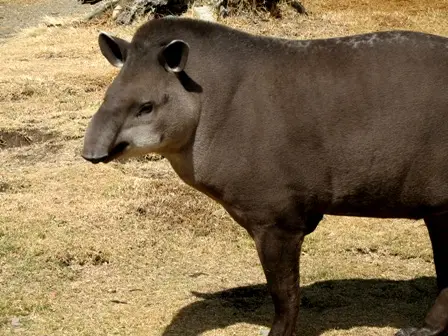
Photo: No machine-readable author provided. Exlibris~commonswiki assumed (based on copyright claims). · CC BY-SA 2.5 · Wikimedia Commons Source
Lowland Tapir
Tapirus terrestris (Lowland Tapir · アメリカバク)
💡 Everyday Comparisons for Size, Mass & Speed
- 💡 Its maximum weight of 250 kg is about twelve and a half 20 kg bags of rice (Comparison).
- 💡 In rural villages, it is hunted for its hide and meat and serves as an important source of protein. In Brazil, it has also been tamed to pull plows and give rides to children.
Reference standards: coach bus ~12 m, mid-size car ~4.9 m, compact car ~1 t, basketball hoop 3.05 m, credit card 8.56 cm.
Site-computed relative index from recorded values; not a formal scientific metric.
📖 1. Overview
The Lowland Tapir is a hoofed animal living in South American forests, with a nose extended like a short elephant trunk.
🦴 2. Anatomy & Morphology
It has a hump-like crest on the top of its skull followed by a short mane. Adults are dark brown to reddish, while young have horizontal white stripes on a brown background that fade after about 7 months. It has a soft snout formed by the nose and upper lip.
🔍 3. Ecology & Behavior
It comes out at night to eat plants such as fruits and leaves. It usually lives alone and hides in the forest during the day. It has poor eyesight but a keen sense of smell and is a strong swimmer.
🇰🇷 4. Connection to Korea
No direct record connecting this species to Korea has been found.
📚 Sources & References
- • IUCN Red List VU (2019) — https://www.iucnredlist.org/species/21474/45174127
- • IUCN Red List category VU — latest assessment at iucnredlist.org
- • mammaldiversity.org — 1006119
- • iucnredlist.org — 45174127
- • wikidata.org — Q220271
- • commons.wikimedia.org — File:Tapirus terrestris.jpg
- • animaldiversity.org — Tapirus terrestris
- • Silhouette: PhyloPic — Lucas Damásio · Public Domain Mark 1.0
Recorded dimensions are widely cited representative estimates from public literature and may vary by study or specimen.