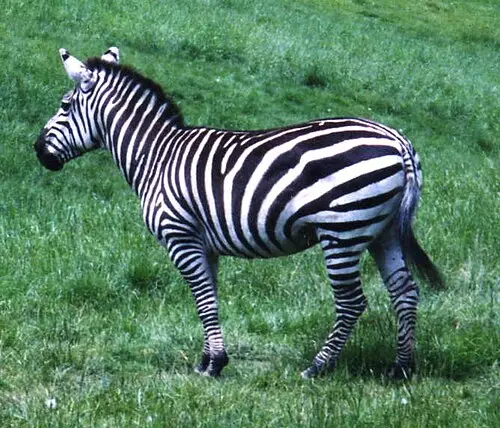
 📸 Photo
Photo: Ltshears · Public domain · Wikimedia Commons Source
Plains Zebra
Equus quagga (Plains Zebra · サバンナシマウマ)
💡 Everyday Comparisons for Size, Mass & Speed
- 💡 Built for speed and endurance, it can reach top speeds of 60–70 km/h—similar to the speed limit on an urban expressway (Comparison).
- 💡 A male's maximum shoulder height of 1.47 m is about the height of an upper-grade elementary school child (Comparison).
Reference standards: coach bus ~12 m, mid-size car ~4.9 m, compact car ~1 t, basketball hoop 3.05 m, credit card 8.56 cm.
Site-computed relative index from recorded values; not a formal scientific metric.
📖 1. Overview
The Plains Zebra is the most widespread wild equid species, living in family groups on African grasslands.
🦴 2. Anatomy & Morphology
Its sturdy horse-like body has bold black-and-white stripes that are unique to each individual, and its coat is dense.
🔍 3. Ecology & Behavior
Over 90% of its diet is grass, favoring stems, leaves, and seeds, and it digs up rhizomes when conditions are very dry. Family units of one stallion and up to six mares gather to form large herds of hundreds of individuals.
🇰🇷 4. Connection to Korea
No direct record connecting this species to Korea has been found.
📚 Sources & References
- • IUCN Red List NT (2016) — https://www.iucnredlist.org/species/41013/45172424
- • IUCN Red List category NT — latest assessment at iucnredlist.org
- • mammaldiversity.org — 1006127
- • iucnredlist.org — 45172424
- • wikidata.org — Q245305
- • commons.wikimedia.org — File:GrantsZebra2.jpg
- • ielc.libguides.com — characteristics
- • ielc.libguides.com — behavior
- • ielc.libguides.com — diet
- • ielc.libguides.com — distribution
- • Silhouette: PhyloPic — author not recorded · CC0 1.0
Recorded dimensions are widely cited representative estimates from public literature and may vary by study or specimen.