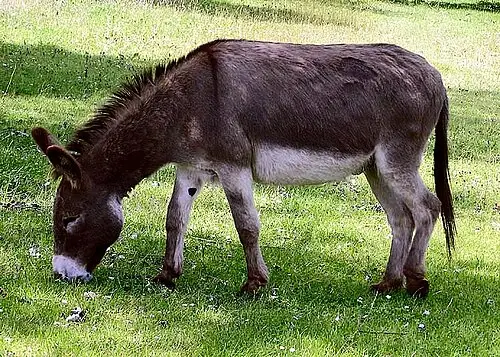
 📸 Photo
Photo: Adrian Pingstone · Public domain · Wikimedia Commons Source
Domestic Ass
Equus asinus (Domestic Ass · ロバ)
Not Evaluated (NE) on the IUCN Red List yet.
💡 Everyday Comparisons for Size, Mass & Speed
- 💡 It is used as a livestock guardian, chasing or kicking away approaching coyotes, foxes, bobcats, and cougars to protect farm animals.
- 💡 It is used to carry heavy loads over long distances.
- 💡 Its maximum shoulder height of 1.4 m is about the height of an upper-grade elementary school child (Comparison).
Reference standards: coach bus ~12 m, mid-size car ~4.9 m, compact car ~1 t, basketball hoop 3.05 m, credit card 8.56 cm.
Site-computed relative index from recorded values; not a formal scientific metric.
📖 1. Overview
The Domestic Ass is a domesticated animal descended from the African wild ass that has long been used to carry loads in arid regions.
🦴 2. Anatomy & Morphology
Its coat is mainly gray with a white belly, muzzle, inner ears, eye rings, and legs, along with a dark dorsal stripe and horizontal leg stripes. Its wide molars have shallow grooves well suited for grinding grass.
🔍 3. Ecology & Behavior
Depending on season and plant availability, it eats grasses, weeds, and shrubs. Males defend territories marked with dung piles, and a typical herd consists of one male and about ten females.
🇰🇷 4. Connection to Korea
No direct record connecting this species to Korea has been found.
📚 Sources & References
- • IUCN Red List: not evaluated (NE) — cross-checked with the Wikidata conservation-status entry
- • mammaldiversity.org — 1006121
- • wikidata.org — Q19829417
- • commons.wikimedia.org — File:Donkey in Clovelly, North Devon, England.jpg
- • animaldiversity.org — Equus asinus
- • Silhouette: PhyloPic — Steven Traver · CC0 1.0
Recorded dimensions are widely cited representative estimates from public literature and may vary by study or specimen.