 📸 Photo
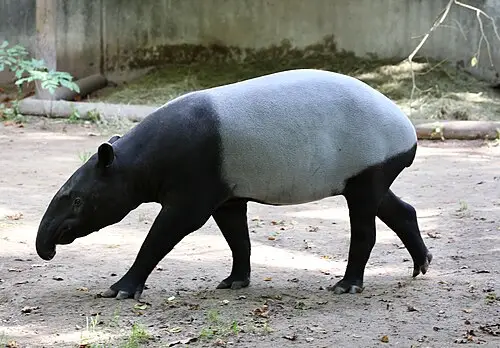
Photo: Rufus46 · CC BY-SA 3.0 · Wikimedia Commons Source
Malayan Tapir
Tapirus indicus (Malayan Tapir · マレーバク)
💡 Everyday Comparisons for Size, Mass & Speed
- 💡 It can walk along deep riverbeds and hold its breath for up to 90 seconds.
- 💡 In Sumatra, cases have been reported where it stripped bark from rubber trees and ate watermelons and cucumbers.
- 💡 Its maximum body length of 2.5 m is slightly more than half the length of a passenger car (about 4.5 m) (Comparison).
Reference standards: coach bus ~12 m, mid-size car ~4.9 m, compact car ~1 t, basketball hoop 3.05 m, credit card 8.56 cm.
Site-computed relative index from recorded values; not a formal scientific metric.
📖 1. Overview
The Malayan Tapir is a tapir of Southeast Asian tropical forests, marked with a black front and a white rear "saddle" pattern.
🦴 2. Anatomy & Morphology
It uses a short proboscis formed by its nose and upper lip, and has 4 toes on each forefoot and 3 on each hind foot. Calves have spots and stripes that fade at around 6 months of age.
🔍 3. Ecology & Behavior
It selectively browses on the leaves, shoots, twigs, and fruits of over 122 plant species, eating 4–5% of its body weight a day. After a gestation of 390–410 days, females usually give birth to a single young once every two years.
🇰🇷 4. Connection to Korea
No direct record connecting this species to Korea has been found.
📚 Sources & References
- • IUCN Red List EN (2016) — https://www.iucnredlist.org/species/21472
- • IUCN Red List category EN — latest assessment at iucnredlist.org
- • mammaldiversity.org — 1006117
- • iucnredlist.org — 21472
- • wikidata.org — Q192710
- • commons.wikimedia.org — File:Schabrackentapir Tapirus indicus Tiergarten-Nuernberg-1
- • animaldiversity.org — Tapirus indicus
- • Silhouette: PhyloPic — Christophe Mallet · CC0 1.0
Recorded dimensions are widely cited representative estimates from public literature and may vary by study or specimen.