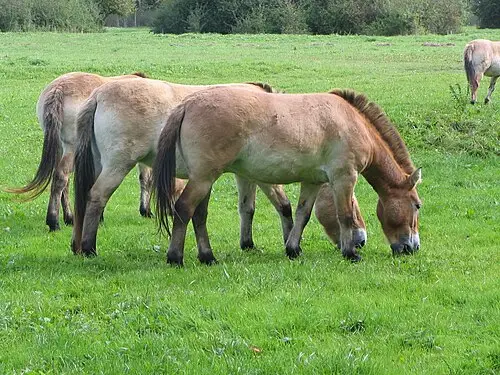
 📸 Photo
Photo: No machine-readable author provided. GerardM assumed (based on copyright claims). · CC BY-SA 3.0 · Wikimedia Commons Source
Wild Horse
Equus ferus (Wild Horse · ノウマ)
💡 Everyday Comparisons for Size, Mass & Speed
- 💡 While domestic horses have 64 chromosomes, this horse has 66, and it is estimated to have diverged from the ancestor of domestic horses about 500,000 years ago.
- 💡 About 1,900 individuals are alive today, all descended from 14 wild-caught individuals.
- 💡 Its maximum body length of 2.6 m is slightly more than half the length of a passenger car (about 4.5 m) (Comparison).
Reference standards: coach bus ~12 m, mid-size car ~4.9 m, compact car ~1 t, basketball hoop 3.05 m, credit card 8.56 cm.
Site-computed relative index from recorded values; not a formal scientific metric.
📖 1. Overview
The Wild Horse (Przewalski's horse) once lived on the Mongolian steppes, disappeared from the wild after the 1960s, and now lives in reintroduction sites.
🦴 2. Anatomy & Morphology
It has a stocky build, a large head, and short legs. Its mane stands upright with no forelock, and a dark stripe runs along the spine to the tail.
🔍 3. Ecology & Behavior
It feeds on grasses and shrub leaves and needs to drink plenty of water. Absent from the wild after the 1960s, it now lives in reintroduction sites in Mongolia and elsewhere.
🇰🇷 4. Connection to Korea
No direct record connecting this species to Korea has been found.
📚 Sources & References
- • IUCN Red List EN (2015) — https://www.iucnredlist.org/species/41763/97204950
- • IUCN Red List category EN — latest assessment at iucnredlist.org
- • mammaldiversity.org — 1006123
- • iucnredlist.org — 97204950
- • wikidata.org — Q27742
- • commons.wikimedia.org — File:Przewalski 26-9-2004-2.jpg
- • nationalzoo.si.edu — przewalskis-horse
- • Silhouette: PhyloPic — Andy Wilson · CC0 1.0
Recorded dimensions are widely cited representative estimates from public literature and may vary by study or specimen.