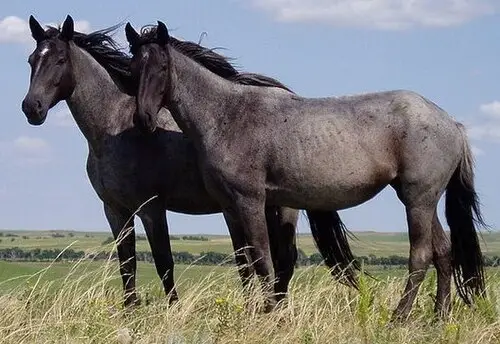
 📸 Photo
Photo: Nokota_Horses.jpg : François Marchal derivative work: Dana boomer ( talk ) · CC BY-SA 3.0 · Wikimedia Commons Source
Domestic Horse
Equus caballus (Domestic Horse · エクウス・カバルス)
Not Evaluated (NE) on the IUCN Red List yet.
💡 Everyday Comparisons for Size, Mass & Speed
- 💡 Used for transporting people and goods, warfare, sports, and farming (pulling plows and carts), it now also serves as a companion animal and in therapeutic riding.
- 💡 Its meat is eaten, horse manure is used as fertilizer, and horsehair is a material for various products.
- 💡 Its maximum weight of 900 kg equals the weight of forty-five 20 kg bags of rice (Comparison).
Reference standards: coach bus ~12 m, mid-size car ~4.9 m, compact car ~1 t, basketball hoop 3.05 m, credit card 8.56 cm.
Site-computed relative index from recorded values; not a formal scientific metric.
📖 1. Overview
The Domestic Horse is a hoofed animal long raised by humans that grazes in herds on grasslands.
🦴 2. Anatomy & Morphology
Having a single toe on each foot, it stands on rounded hooves and has long slender legs, a long thick neck, and molars suited for grinding grass. Wild horses have short, upright manes, whereas domestic horses have long, draping manes.
🔍 3. Ecology & Behavior
It mainly grazes on grass, while domestic horses are also fed oats, barley, corn, and hay. In the wild, 5–11 mares and 1–4 stallions form a herd with their young and maintain a social hierarchy.
🇰🇷 4. Connection to Korea
No direct record connecting this species to Korea has been found.
📚 Sources & References
- • IUCN Red List: not evaluated (NE) — cross-checked with the Wikidata conservation-status entry
- • mammaldiversity.org — 1006122
- • wikidata.org — Q10758650
- • commons.wikimedia.org — File:Nokota Horses cropped.jpg
- • animaldiversity.org — Equus caballus
- • Silhouette: PhyloPic — Mercedes Yrayzoz (vectorized by T. Michael Keesey) · CC BY 3.0
Recorded dimensions are widely cited representative estimates from public literature and may vary by study or specimen.