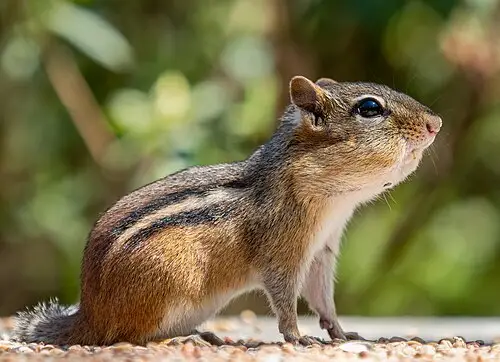
 📸 Photo
Photo: Rhododendrites · CC BY-SA 4.0 · Wikimedia Commons Source
Eastern Chipmunk
Tamias striatus (Eastern Chipmunk · トウブシマリス)
💡 Everyday Comparisons for Size, Mass & Speed
- 💡 Its maximum weight of 115 g is about two chicken eggs (around 60 g each), and its length of 26.6 cm is slightly shorter than a 30 cm ruler (Comparison).
- 💡 By eating insects it can help reduce pest populations, and because it is easily tamed it is sometimes kept as a pet (Animal Diversity Web).
Reference standards: coach bus ~12 m, mid-size car ~4.9 m, compact car ~1 t, basketball hoop 3.05 m, credit card 8.56 cm.
Site-computed relative index from recorded values; not a formal scientific metric.
📖 1. Overview
The Eastern Chipmunk is a small striped rodent of eastern North American forests that spends most of its life on the ground.
🦴 2. Anatomy & Morphology
It has grayish to reddish-brown fur with a yellowish patch on the rump and five dark stripes along its sides and back. Large cheek pouches sit on both sides of its mouth.
🔍 3. Ecology & Behavior
It feeds mainly on fruits, seeds, and nuts along with insects, earthworms, slugs, bird eggs, and mushrooms, carrying food in its cheek pouches to store in its burrow and across its territory. Lacking enough fat stores for true hibernation, it enters torpor and wakes frequently to feed.
🇰🇷 4. Connection to Korea
No direct record connecting this species to Korea has been found.
📚 Sources & References
- • IUCN Red List LC (2016) — https://www.iucnredlist.org/species/42583/115191543
- • IUCN Red List category LC — latest assessment at iucnredlist.org
- • mammaldiversity.org — 1001785
- • iucnredlist.org — 115191543
- • wikidata.org — Q692664
- • commons.wikimedia.org — File:Chipmunk with stuffed cheeks in Prospect Park (05980).j
- • animaldiversity.org — Tamias striatus
- • Silhouette: PhyloPic — Chloé Schmidt · CC BY 3.0
Recorded dimensions are widely cited representative estimates from public literature and may vary by study or specimen.