 📸 Photo
Photo: Public domain · Public domain · Wikimedia Commons Source
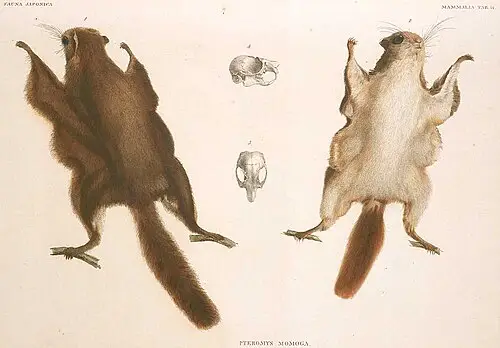
Japanese Flying Squirrel
Pteromys momonga (Japanese Flying Squirrel · ニホンモモンガ)
💡 Everyday Comparisons for Size, Mass & Speed
- 💡 Its maximum head-and-body length of 22.8 cm is slightly longer than the short side of an A4 sheet of paper (21 cm) (Comparison).
- 💡 Animal Diversity Web notes that flying squirrels around the world have been traded as pets and used for their fur.
Reference standards: coach bus ~12 m, mid-size car ~4.9 m, compact car ~1 t, basketball hoop 3.05 m, credit card 8.56 cm.
📖 1. Overview
The Japanese Flying Squirrel is a small flying squirrel that glides between trees at night in evergreen forests, blending in with tree bark so well that it is hard to spot.
🦴 2. Anatomy & Morphology
Its back is silvery to buffy gray, its belly is buffy white, and its gliding membrane extends from the ankles to the wrists. There is no membrane between the hind legs and the base of the tail.
🔍 3. Ecology & Behavior
Strictly nocturnal and silent in flight, it eats nuts, pine seeds, tree buds and bark, and fruits. It usually gives birth to 1–5 young (averaging 2–3) in May and sometimes produces a second litter in June–July.
🇰🇷 4. Connection to Korea
No direct record connecting this species to Korea has been found.
📚 Sources & References
- • IUCN Red List LC (2016) — https://www.iucnredlist.org/species/18701/22270866
- • IUCN Red List category LC — latest assessment at iucnredlist.org
- • mammaldiversity.org — 1001665
- • iucnredlist.org — 22270866
- • wikidata.org — Q1766561
- • commons.wikimedia.org — File:Pteromys momonga fauna japonica.jpg
- • animaldiversity.org — Pteromys momonga
- • Silhouette: PhyloPic — Margot Michaud · CC0 1.0 (Congeneric silhouette — Pteromys volans)
Recorded dimensions are widely cited representative estimates from public literature and may vary by study or specimen.