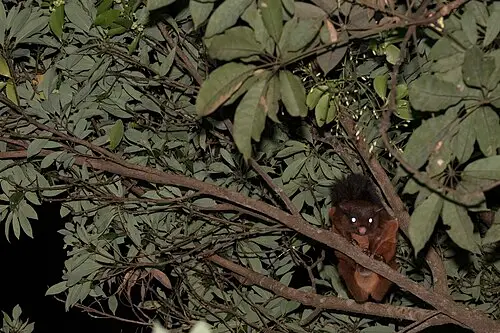
 📸 Photo
Photo: Licheng Shih · CC BY 4.0 · Wikimedia Commons Source
Formosan Giant Flying Squirrel
Petaurista grandis (Formosan Giant Flying Squirrel · Formosan Giant Flying Squirrel)
Not Evaluated (NE) on the IUCN Red List yet.
💡 Everyday Comparisons for Size, Mass & Speed
- 💡 Its weight of about 1.3 kg is slightly heavier than a 1 kg bag of rice (Comparison). Its elevation range up to 2,500 m reaches higher than Hallasan (1,947 m) (Comparison).
- 💡 As natural forests at low and mid elevations were logged, it adapted to human-planted forests and began gnawing tree bark, which has been reported to damage trees (National Museum of Natural Science, Taiwan).
Reference standards: coach bus ~12 m, mid-size car ~4.9 m, compact car ~1 t, basketball hoop 3.05 m, credit card 8.56 cm.
Site-computed relative index from recorded values; not a formal scientific metric.
📖 1. Overview
The Formosan Giant Flying Squirrel is the most widespread flying squirrel in Taiwan, living high in the canopy of broadleaf and mixed forests.
🦴 2. Anatomy & Morphology
It has reddish-brown fur with a paler belly and a darker tail, and is slightly smaller than the Taiwan red-and-white giant flying squirrel.
🔍 3. Ecology & Behavior
It rests in tree hollows by day and is active in the trees at night; leaves make up over 70% of its diet, supplemented by fruits, flower buds, bark, and occasional insects. Because it freezes when a light is shone on it at night, it can become an easy target for hunters.
🇰🇷 4. Connection to Korea
No direct record connecting this species to Korea has been found.
📚 Sources & References
- • IUCN Red List: not evaluated (NE) — cross-checked with the Wikidata conservation-status entry
- • mammaldiversity.org — 1001642
- • wikidata.org — Q113303173
- • nmns.edu.tw — Collection-E00302
- • Silhouette: PhyloPic — Joseph Smit · Public Domain Mark 1.0 (Related taxon silhouette — Sciurillus pusillus)
Recorded dimensions are widely cited representative estimates from public literature and may vary by study or specimen.