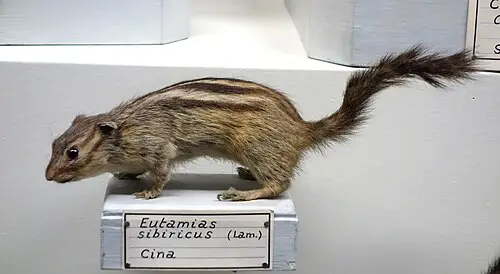
 📸 Photo
Photo: Daderot · CC0 · Wikimedia Commons Source
Siberian Chipmunk
Eutamias sibiricus (Siberian Chipmunk · Siberian Chipmunk)
💡 Everyday Comparisons for Size, Mass & Speed
- 💡 Its maximum weight of about 150 g equals the weight of two or three chicken eggs (Comparison).
- 💡 Escaped captive individuals have established populations in eastern Europe.
Reference standards: coach bus ~12 m, mid-size car ~4.9 m, compact car ~1 t, basketball hoop 3.05 m, credit card 8.56 cm.
Site-computed relative index from recorded values; not a formal scientific metric.
📖 1. Overview
The Siberian Chipmunk is a small striped squirrel distributed from northern Asia to Korea and northern Japan, and is the only species of the genus Tamias living outside North America.
🦴 2. Anatomy & Morphology
Its back is yellowish-brown and its chest and belly are white, with five dark stripes and four pale stripes running down the back. Males and females look alike.
🔍 3. Ecology & Behavior
An omnivore that eats seeds, grains, nuts, fruits, mushrooms, insects, and even small birds and lizards, it caches food in its burrow. By dispersing buried seeds and mushroom spores, it benefits forest ecosystems.
🇰🇷 4. Connection to Korea
It is listed as 'Daramjwi' (Korean name) on the National List of Species of Korea (National Institute of Biological Resources (NIBR)), and Korea is included in its recorded distribution.
📚 Sources & References
- • IUCN Red List LC (2016) — https://www.iucnredlist.org/species/21360/115161465
- • IUCN Red List category LC — latest assessment at iucnredlist.org
- • mammaldiversity.org — 1001719
- • iucnredlist.org — 115161465
- • 국가생물종목록(국립생물자원관) ktsn 120000225561 — https://species.nibr.go.kr/home/mainHome.do?cont_link=009&subMenu=009002&contCd=009002&ktsn=120000225561
- • wikidata.org — Q24662784
- • commons.wikimedia.org — File:Eutamias sibiricus - Museo Civico di Storia Naturale Gi
- • animaldiversity.org — Tamias sibiricus
- • species.nibr.go.kr — general-search
- • Silhouette: PhyloPic — Nina Skinner · CC BY 3.0
Recorded dimensions are widely cited representative estimates from public literature and may vary by study or specimen.