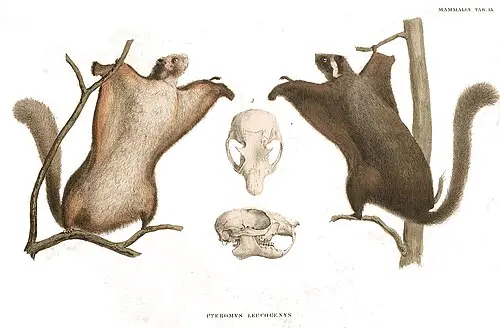
 📸 Photo
Photo: Public domain · Public domain · Wikimedia Commons Source
Japanese Giant Flying Squirrel
Petaurista leucogenys (Japanese Giant Flying Squirrel · ムササビ)
💡 Everyday Comparisons for Size, Mass & Speed
- 💡 Its average glide of 50 m equals the length of an Olympic swimming pool, and its longest glide of 160.2 m is 1.5 times the length of a soccer field (about 105 m) (Comparison). Its maximum weight of 1.3 kg is slightly heavier than a 1 kg bag of rice (Comparison).
- 💡 It often lives in forests around shrines and temples, and giant flying squirrels around the world are sometimes hunted for food (Animal Diversity Web).
Reference standards: coach bus ~12 m, mid-size car ~4.9 m, compact car ~1 t, basketball hoop 3.05 m, credit card 8.56 cm.
Site-computed relative index from recorded values; not a formal scientific metric.
📖 1. Overview
The Japanese Giant Flying Squirrel is the largest of the giant flying squirrels, gliding between trees at night and almost never coming down to the ground.
🦴 2. Anatomy & Morphology
Its fur is long and soft, with back colors varying from yellowish-gray and brown to chestnut and black. A fur-covered gliding membrane stretches from the wrists to the ankles, and the tail is usually longer than the body.
🔍 3. Ecology & Behavior
It rests in tree hollows during the day and feeds on seeds, leaves, buds, fruits, and flowers according to the season at night. A single glide averages 50 m, with the longest recorded glide reaching 160.2 m.
🇰🇷 4. Connection to Korea
No direct record connecting this species to Korea has been found.
📚 Sources & References
- • IUCN Red List LC (2016) — https://www.iucnredlist.org/species/16720/115138197
- • IUCN Red List category LC — latest assessment at iucnredlist.org
- • mammaldiversity.org — 1001645
- • iucnredlist.org — 115138197
- • wikidata.org — Q1765345
- • commons.wikimedia.org — File:Pteromys leucogenys fauna japonica.jpg
- • animaldiversity.org — Petaurista leucogenys
- • Silhouette: PhyloPic — author not recorded · Public Domain Mark 1.0
Recorded dimensions are widely cited representative estimates from public literature and may vary by study or specimen.