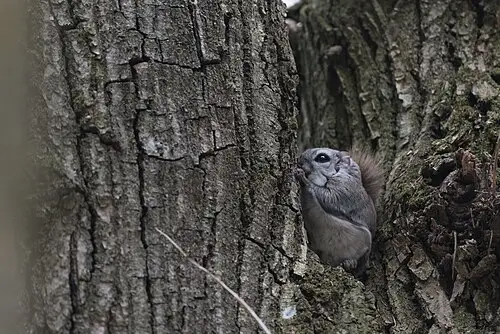
 📸 Photo
Photo: Чеканов Павел · CC BY-SA 4.0 · Wikimedia Commons Source
Siberian Flying Squirrel
Pteromys volans (Siberian Flying Squirrel · タイリクモモンガ)
🇰🇷 Class II endangered wildlife (Korea) (subspecies Pteromys volans aluco) · Natural Monument (Korea) «Siberian Flying Squirrel»
💡 Everyday Comparisons for Size, Mass & Speed
- 💡 Its average weight of 130 g is just over the weight of two eggs (Comparison).
- 💡 Its maximum head-and-body length of 22.8 cm is slightly longer than the short side of an A4 sheet of paper (21 cm) (Comparison).
- 💡 Because it is a protected species designated as a Natural Monument (Korea), it should only be observed with the eyes if encountered in the forest.
Reference standards: coach bus ~12 m, mid-size car ~4.9 m, compact car ~1 t, basketball hoop 3.05 m, credit card 8.56 cm.
Site-computed relative index from recorded values; not a formal scientific metric.
📖 1. Overview
The Siberian Flying Squirrel is a small rodent living in forests from Siberia to Northeast Asia that spreads the skin membrane between its forelegs and hindlegs to glide from tree to tree.
🦴 2. Anatomy & Morphology
It has a gliding membrane (patagium) between its forelegs and hindlegs, large dark eyes, and a flat tail covered in short hair. Its fur is long and soft, and its belly remains white year-round.
🔍 3. Ecology & Behavior
A nocturnal animal active from about 30 minutes to 1 hour after sunset until dawn, it eats grass, young twigs, fruits, and seeds in summer, and nuts, catkins, and pine cones in winter. It nests in tree hollows or among branches, and several individuals may gather in a single tree.
🇰🇷 4. Connection to Korea
In Korea, the subspecies Pteromys volans aluco is designated as Class II endangered wildlife (Korea), and "Haneuldaramjwi" (Korean name) was designated as a Natural Monument (Korea) on November 16, 1982.
📚 Sources & References
- • IUCN Red List LC (2016) — https://www.iucnredlist.org/species/18702/115144995
- • 멸종위기 야생생물 Ⅱ급 (아종 Pteromys volans aluco) · 천연기념물 «하늘다람쥐» — 국가생물종목록(국립생물자원관) ktsn 120000053439 — https://species.nibr.go.kr/home/mainHome.do?cont_link=009&subMenu=009002&contCd=009002&ktsn=120000053439
- • IUCN Red List category LC — latest assessment at iucnredlist.org
- • Korean protection status: Class II endangered wildlife (Korea) (subspecies Pteromys volans aluco) · Natural Monument (Korea) «Siberian Flying Squirrel»
- • mammaldiversity.org — 1001666
- • iucnredlist.org — 115144995
- • 국가생물종목록(국립생물자원관) ktsn 120000053439 — https://species.nibr.go.kr/home/mainHome.do?cont_link=009&subMenu=009002&contCd=009002&ktsn=120000053439
- • 국가생물종목록(국립생물자원관) ktsn 120000212947 — https://species.nibr.go.kr/home/mainHome.do?cont_link=009&subMenu=009002&contCd=009002&ktsn=120000212947
- • heritage.go.kr — culSelectDetail.do
- • wikidata.org — Q243339
- • commons.wikimedia.org — File:Летяга.jpg
- • animaldiversity.org — Pteromys volans
- • Silhouette: PhyloPic — Margot Michaud · CC0 1.0
Recorded dimensions are widely cited representative estimates from public literature and may vary by study or specimen.