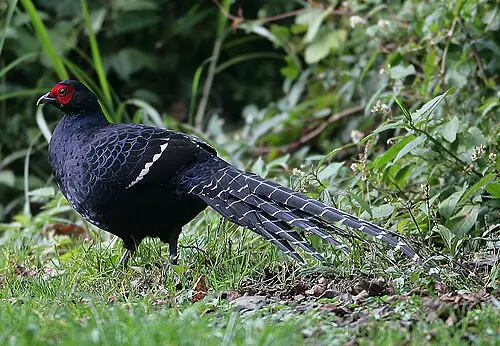
 📸 Photo
Photo: Snowyowls (photographer) / Jako (uploader) · CC BY-SA 3.0 · Wikimedia Commons Source
Mikado Pheasant
Syrmaticus mikado (Mikado Pheasant · ミカドキジ)
💡 Everyday Comparisons for Size, Mass & Speed
- 💡 A male's total length of about 70 cm is similar to the height of a standard desk (about 70 cm) (Comparison).
- 💡 To the people of Taiwan, it is an endemic bird found only on their island, and it occasionally appears in planted forests and secondary forests.
Reference standards: coach bus ~12 m, mid-size car ~4.9 m, compact car ~1 t, basketball hoop 3.05 m, credit card 8.56 cm.
📖 1. Overview
The Mikado Pheasant is a pheasant endemic to Taiwan that lives in high mountain forests at elevations of 1,600–3,300 m. The male's long black tail is marked with white bars.
🦴 2. Anatomy & Morphology
Males have a dark blue to black body, crimson facial wattles, and bluish-green wings with white bars. The tail is very long with about 15 white crossbars, while females are smaller and olive to black with white mottling on the belly.
🔍 3. Ecology & Behavior
It feeds on berries, young leaves, shoots, flower buds, fern fronds, young roots, and insects. It breeds from April to August, laying 2–8 eggs per clutch, and is occasionally seen in planted forests or secondary forests.
🇰🇷 4. Connection to Korea
No direct record connecting this species to Korea has been found.
📚 Sources & References
- • IUCN Red List LC (2023) — https://www.iucnredlist.org/species/22679336/219037214
- • IUCN Red List category LC — latest assessment at iucnredlist.org
- • doi.org — avilist.v2026
- • iucnredlist.org — 219037214
- • wikidata.org — Q715266
- • commons.wikimedia.org — File:Mikado Pheasant 398.jpg
- • culture.teldap.tw — index.php
- • Silhouette: PhyloPic — author not recorded · Public Domain Mark 1.0 (Related taxon silhouette — Arborophila hyperythra)
Recorded dimensions are widely cited representative estimates from public literature and may vary by study or specimen.