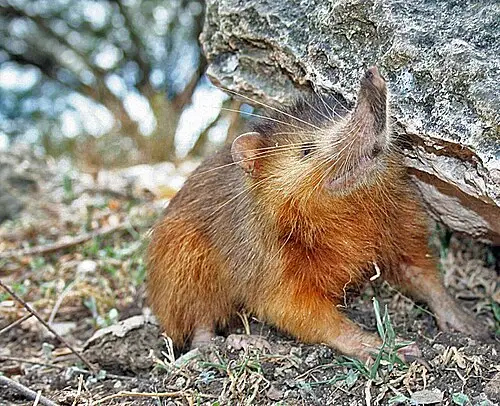
 📸 Photo
Photo: Seb az86556 · CC BY-SA 3.0 · Wikimedia Commons Source
Hispaniolan Solenodon
Solenodon paradoxus (Hispaniolan Solenodon · ハイチソレノドン)
💡 Everyday Comparisons for Size, Mass & Speed
- 💡 Its maximum weight of 1 kg equals a 1 L carton of milk, and its maximum body length of 33 cm is slightly longer than the long side of an A4 sheet of paper (29.7 cm) (Comparison).
- 💡 Its diet list includes soil invertebrates such as millipedes, and it is well known for its clumsy, zigzagging gait.
Reference standards: coach bus ~12 m, mid-size car ~4.9 m, compact car ~1 t, basketball hoop 3.05 m, credit card 8.56 cm.
Site-computed relative index from recorded values; not a formal scientific metric.
📖 1. Overview
The Hispaniolan Solenodon is a nocturnal, burrowing mammal that resembles a rat or shrew but is much larger.
🦴 2. Anatomy & Morphology
Covered in black to reddish-brown fur, it has a large head and an elongated snout. At the tip of the snout sits a small bone (the os proboscis) supporting its long cartilaginous nose, and its second lower incisor has a groove that channels venom.
🔍 3. Ecology & Behavior
By day it shelters in underground burrows, hollow logs, or rock crevices, and at night it digs through soil in search of insects and other invertebrates. Sources disagree on whether it eats plant matter, and it breeds very slowly, producing only two litters a year.
🇰🇷 4. Connection to Korea
No direct record connecting this species to Korea has been found.
📚 Sources & References
- • IUCN Red List LC (2020) — https://www.iucnredlist.org/species/20321/22327218
- • IUCN Red List category LC — latest assessment at iucnredlist.org
- • mammaldiversity.org — 1003840
- • iucnredlist.org — 22327218
- • wikidata.org — Q754041
- • commons.wikimedia.org — File:Hispaniolan Solenodon crop.jpg
- • animaldiversity.org — Solenodon paradoxus
- • Silhouette: PhyloPic — Inessa Voet · CC0 1.0
Recorded dimensions are widely cited representative estimates from public literature and may vary by study or specimen.