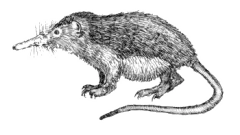
 📸 Photo
Photo: Monika Betley · Public domain · Wikimedia Commons Source
Cuban Solenodon
Atopogale cubana (Cuban Solenodon · Cuban Solenodon)
💡 Everyday Comparisons for Size, Mass & Speed
- 💡 Its weight of about 1 kg equals a small 1 kg bag of rice (Comparison).
- 💡 Clearing forests for farmland and introduced predators are cited as the main causes of its decline.
Reference standards: coach bus ~12 m, mid-size car ~4.9 m, compact car ~1 t, basketball hoop 3.05 m, credit card 8.56 cm.
Site-computed relative index from recorded values; not a formal scientific metric.
📖 1. Overview
The Cuban solenodon is a nocturnal, shrew-like animal living in the mountain forests of eastern Cuba, once thought extinct before being rediscovered.
🦴 2. Anatomy & Morphology
It has a large head, tiny eyes, and a long, protruding snout. Its ears are partly hairless, and its thick, scaly tail is nearly bare.
🔍 3. Ecology & Behavior
It rests in rock crevices, tree hollows, or burrows during the day, emerging at night to dig up the ground with its snout and claws for insects, earthworms, small reptiles, carrion, roots, and fruits. Females give birth to 1–2 young per litter about 2 times a year.
🇰🇷 4. Connection to Korea
No direct record connecting this species to Korea has been found.
📚 Sources & References
- • IUCN Red List EN (2018) — https://www.iucnredlist.org/species/20320/22327125
- • IUCN Red List category EN — latest assessment at iucnredlist.org
- • mammaldiversity.org — 1003837
- • iucnredlist.org — 22327125
- • wikidata.org — Q34486275
- • commons.wikimedia.org — File:Dixi-Solenodon cubanus-transparent.png
- • animaldiversity.org — Solenodon cubanus
- • Silhouette: PhyloPic — T. Michael Keesey (after Monika Betley) · CC0 1.0
Recorded dimensions are widely cited representative estimates from public literature and may vary by study or specimen.