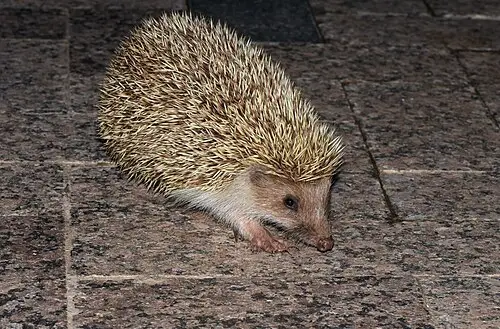
 📸 Photo
Photo: Zinogre · CC BY-SA 4.0 · Wikimedia Commons Source
Amur Hedgehog
Erinaceus amurensis (Amur Hedgehog · アムールハリネズミ)
💡 Everyday Comparisons for Size, Mass & Speed
- 💡 Its maximum head-and-body length of 30 cm is almost the same as the long side of A4 paper (29.7 cm) (Comparison).
- 💡 Because it adapts well to captivity and becomes tame, it is sometimes kept as a pet.
Reference standards: coach bus ~12 m, mid-size car ~4.9 m, compact car ~1 t, basketball hoop 3.05 m, credit card 8.56 cm.
Site-computed relative index from recorded values; not a formal scientific metric.
📖 1. Overview
The Amur Hedgehog is a terrestrial mammal with a back covered in sharp spines, living from the Amur River basin of Russia through the Korean Peninsula to central and eastern China.
🦴 2. Anatomy & Morphology
It has a stocky body, short ears and tail, and back spines that grow up to 24 mm long. Its spines not only deter predators but also cushion impacts when falling from high places.
🔍 3. Ecology & Behavior
Active at night, it feeds mainly on beetles, caterpillars, slugs, earthworms, and spiders, and also eats mushrooms, berries, frogs, and discarded human food. When threatened it rolls into a ball; it hibernates in winter (starting in October in China) and produces 1–2 litters of 4–6 young per year.
🇰🇷 4. Connection to Korea
It is listed on the National List of Species of Korea (National Institute of Biological Resources (NIBR)) and is distributed across the Korean Peninsula. It has no separate statutory protection status in Korea.
📚 Sources & References
- • IUCN Red List LC (2016) — https://www.iucnredlist.org/species/40604/115174360
- • IUCN Red List category LC — latest assessment at iucnredlist.org
- • mammaldiversity.org — 1003808
- • iucnredlist.org — 115174360
- • 국가생물종목록(국립생물자원관) ktsn 120000053230 — https://species.nibr.go.kr/home/mainHome.do?cont_link=009&subMenu=009002&contCd=009002&ktsn=120000053230
- • wikidata.org — Q1070063
- • tb.plazi.org — 038787D0FFD3FFC2FA68F711FAC578A9
- • Silhouette: PhyloPic — Adriana K. · CC0 1.0 (Congeneric silhouette — Erinaceus)
Recorded dimensions are widely cited representative estimates from public literature and may vary by study or specimen.