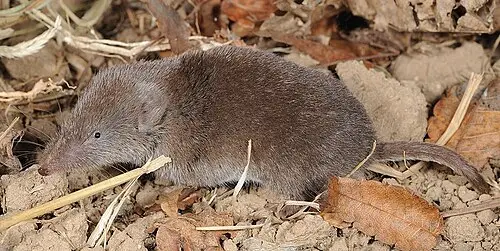
 📸 Photo
Photo: Hyun-tae Kim · CC BY 4.0 · Wikimedia Commons Source
Ussuri White-toothed Shrew
Crocidura lasiura (Ussuri White-toothed Shrew · Ussuri White-toothed Shrew)
💡 Everyday Comparisons for Size, Mass & Speed
- 💡 Living around fields and streams, its maximum weight of 26.7 g is similar to three or four Korean 500-won coins (about 7.7 g each) (Comparison).
- 💡 Its maximum head-and-body length of 10 cm is about half the short side of A4 paper (21 cm) (Comparison).
Reference standards: coach bus ~12 m, mid-size car ~4.9 m, compact car ~1 t, basketball hoop 3.05 m, credit card 8.56 cm.
Site-computed relative index from recorded values; not a formal scientific metric.
📖 1. Overview
The Ussuri White-toothed Shrew is a large shrew living in the Korean Peninsula, northeastern China, and the Russian Far East that leads a semi-aquatic lifestyle near water.
🦴 2. Anatomy & Morphology
Its body is large and sturdy, and its tail is often shorter than half the head-and-body length. Its fur is a uniform dark brown with a slightly paler belly.
🔍 3. Ecology & Behavior
It feeds mainly on spiders (especially harvestmen), beetles, and moth larvae, and also catches aquatic beetles, snails, and young fish to eat on land. It is active in short bouts throughout the day and gives birth to 4–6 young per litter from February to October in Korea.
🇰🇷 4. Connection to Korea
It is listed on the National List of Species of Korea (National Institute of Biological Resources (NIBR)) and is a common shrew found throughout the Korean Peninsula (excluding distant islands). Gwangju Metropolitan City and Gyeonggi-do have designated it a regionally protected species due to population decline.
📚 Sources & References
- • IUCN Red List LC (2016) — https://www.iucnredlist.org/species/41327/115178387
- • IUCN Red List category LC — latest assessment at iucnredlist.org
- • mammaldiversity.org — 1003925
- • iucnredlist.org — 115178387
- • 국가생물종목록(국립생물자원관) ktsn 120000053235 — https://species.nibr.go.kr/home/mainHome.do?cont_link=009&subMenu=009002&contCd=009002&ktsn=120000053235
- • wikidata.org — Q1768655
- • commons.wikimedia.org — File:Crocidura lasiura 2813469.jpg
- • tb.plazi.org — 3D474A54A072871EFFF1A0621B8CF954
- • tb.plazi.org — 03A0BE3B641BFFACFF4FF92AFBD956E2
- • Silhouette: PhyloPic — Inessa Voet · CC0 1.0 (Congeneric silhouette — Crocidura)
Recorded dimensions are widely cited representative estimates from public literature and may vary by study or specimen.