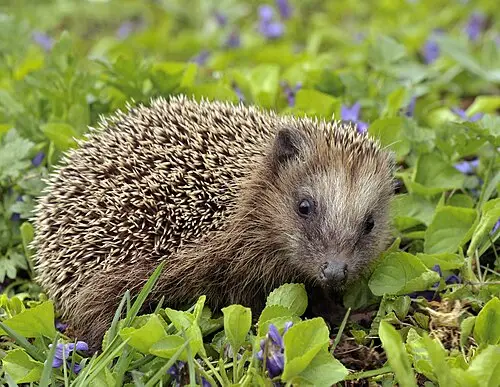
 📸 Photo
Photo: Michael Gäbler · CC BY-SA 3.0 · Wikimedia Commons Source
West European Hedgehog
Erinaceus europaeus (West European Hedgehog · ナミハリネズミ)
💡 Everyday Comparisons for Size, Mass & Speed
- 💡 Its maximum adult weight of 1.2 kg is slightly heavier than a 1 L carton of milk (about 1 kg) (Comparison). Its maximum body length of 16.5 cm is slightly shorter than a pencil (about 17.5 cm) (Comparison).
- 💡 Found near human settlements such as gardens, cemeteries, and parks, it eats many insects and may help reduce pests, while its spines and hair are also used to test for environmental pollutants.
Reference standards: coach bus ~12 m, mid-size car ~4.9 m, compact car ~1 t, basketball hoop 3.05 m, credit card 8.56 cm.
Site-computed relative index from recorded values; not a formal scientific metric.
📖 1. Overview
The West European Hedgehog is a small animal with short legs and a round body that lives along field edges and hedgerows in temperate regions, and can also be seen in gardens and parks where people live.
🦴 2. Anatomy & Morphology
Except for its cheeks, throat, belly, and legs, its entire body is covered in spines about 2–2.5 cm long. Each foot has 5 pads and 5 claws, and its head and snout form an elongated cone.
🔍 3. Ecology & Behavior
Active at night and mostly solitary, it is an omnivore that favors insects such as beetles, ants, and bees, and also eats snails, eggs, frogs, small rodents, and carrion.
🇰🇷 4. Connection to Korea
No direct record connecting this species to Korea has been found.
📚 Sources & References
- • IUCN Red List NT (2024) — https://www.iucnredlist.org/species/29650/213411773
- • IUCN Red List category NT — latest assessment at iucnredlist.org
- • mammaldiversity.org — 1003810
- • iucnredlist.org — 213411773
- • wikidata.org — Q6145
- • commons.wikimedia.org — File:Erinaceus europaeus (Linnaeus, 1758).jpg
- • animaldiversity.org — Erinaceus europaeus
- • Silhouette: PhyloPic — author not recorded · CC0 1.0
Recorded dimensions are widely cited representative estimates from public literature and may vary by study or specimen.