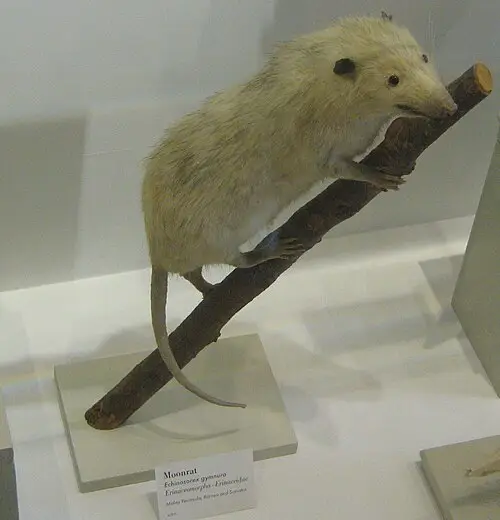
 📸 Photo
Photo: David Starner · CC BY 3.0 · Wikimedia Commons Source
Moonrat
Echinosorex gymnura (Moonrat · ジムヌラ)
💡 Everyday Comparisons for Size, Mass & Speed
- 💡 Its maximum weight of 1.4 kg is similar to a 1.5 L bottle of water, and its maximum head-and-body length of 46 cm is about 1.5 times the long side of A4 paper (29.7 cm) (Comparison).
- 💡 The secretion it rubs on its nest entrance is said to smell like rotten onions. Breeding year-round, females typically have two litters a year of two young each.
Reference standards: coach bus ~12 m, mid-size car ~4.9 m, compact car ~1 t, basketball hoop 3.05 m, credit card 8.56 cm.
Site-computed relative index from recorded values; not a formal scientific metric.
📖 1. Overview
The Moonrat is a member of the hedgehog family living in lowland forests, mangrove swamps, and rubber plantations of Southeast Asia. Instead of spines, it is covered in coarse hair.
🦴 2. Anatomy & Morphology
Its head and the distal part of its tail have white hair while the rest of its body is black, and its scaly tail is sparsely haired. It has a long, mobile nose and an elongated body, and females tend to be larger than males.
🔍 3. Ecology & Behavior
It feeds mainly on invertebrates such as earthworms, insects, spiders, centipedes, crabs, and mollusks, and also eats frogs, fish, and fruits. Solitary, it marks the entrance of its nest with anal gland secretions said to smell like rotten onions or ammonia.
🇰🇷 4. Connection to Korea
No direct record connecting this species to Korea has been found.
📚 Sources & References
- • IUCN Red List LC (2016) — https://www.iucnredlist.org/species/40603/22326807
- • IUCN Red List category LC — latest assessment at iucnredlist.org
- • mammaldiversity.org — 1003822
- • iucnredlist.org — 22326807
- • wikidata.org — Q754046
- • commons.wikimedia.org — File:Echinosorex gymnura Harvard.jpg
- • animaldiversity.org — Echinosorex gymnura
- • Silhouette: PhyloPic — Margot Michaud · CC0 1.0 (Related taxon silhouette — Hylomys suillus)
Recorded dimensions are widely cited representative estimates from public literature and may vary by study or specimen.