 📸 Photo
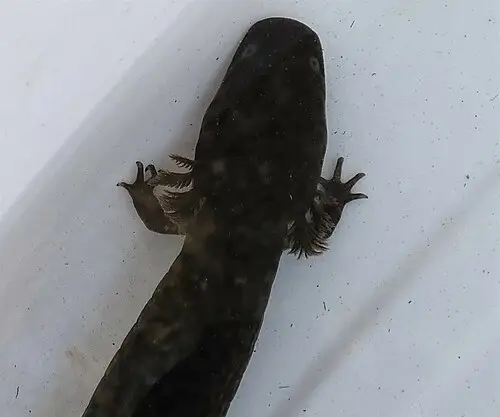
Photo: kcthetc1 · CC0 · Wikimedia Commons Source
Greater Siren
Siren lacertina (Greater Siren · Greater Siren)
💡 Everyday Comparisons for Size, Mass & Speed
- 💡 Its length of 97 cm is nearly equal to a 1 m ruler (Comparison).
- 💡 By preying on aquatic invertebrates and insects, it helps keep their populations in check (ADW, 'Positive Impacts').
- 💡 Its clutch of about 500 eggs equals roughly sixteen trays of eggs (30 eggs per tray) in Korea (Comparison).
Reference standards: coach bus ~12 m, mid-size car ~4.9 m, compact car ~1 t, basketball hoop 3.05 m, credit card 8.56 cm.
📖 1. Overview
The Greater Siren is a large, eel-like salamander without hind legs that spends its entire life underwater in heavily vegetated swamps and ponds. It is assessed as Least Concern (LC, 2022 assessment) on the IUCN Red List.
🦴 2. Anatomy & Morphology
Measuring 49–97 cm in length, it lacks hind legs and has small forelegs with 4 toes each, a round body, and a vertically flattened tail that gives it an eel-like look. Behind its eyes are three-branched external gills, and its olive to gray-brown skin is dotted with black specks.
🔍 3. Ecology & Behavior
Active at night, it eats insects, crustaceans, clams, spiders, crayfish, and small fish, and because algae have been found in its digestive tract some researchers think it may be partly omnivorous. When the water it lives in dries up, it forms a cocoon of dead skin cells in the mud and has been recorded aestivating for up to 5.2 years, and in spring it lays about 500 eggs.
🇰🇷 4. Connection to Korea
No direct record connecting this species to Korea has been found.
📚 Sources & References
- • IUCN Red List LC (2022) — https://www.iucnredlist.org/species/59492/53988286
- • IUCN Red List category LC — latest assessment at iucnredlist.org
- • catalogueoflife.org — 4XR2K
- • iucnredlist.org — 53988286
- • wikidata.org — Q629332
- • commons.wikimedia.org — File:Siren lacertina 259349484.jpg
- • animaldiversity.org — Siren lacertina
- • Silhouette: PhyloPic — New York Zoological Society · Public Domain Mark 1.0
Recorded dimensions are widely cited representative estimates from public literature and may vary by study or specimen.