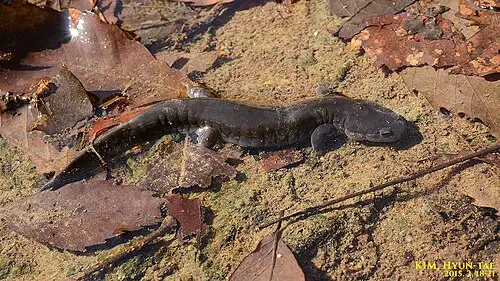
 📸 Photo
Photo: Kim, Hyun-tae · CC BY 4.0 · Wikimedia Commons Source
Kori Salamander
Hynobius yangi (Kori Salamander · Kori Salamander)
🇰🇷 Class II endangered wildlife (Korea)
💡 Everyday Comparisons for Size, Mass & Speed
- 💡 Its body length of 14 cm is similar to that of a ballpoint pen (about 14 cm) (Comparison).
- 💡 Because it lays eggs in valleys, wetlands, rice paddies, ditches, and irrigation channels, the National Institute of Ecology explains that its breeding sites disappear where paddy wetlands shrink and houses and roads expand.
Reference standards: coach bus ~12 m, mid-size car ~4.9 m, compact car ~1 t, basketball hoop 3.05 m, credit card 8.56 cm.
📖 1. Overview
The Kori Salamander is a salamander endemic to Korea that lives only in parts of Gyeongsang-do, including Busan, Ulsan, Yangsan in Gyeongsangnam-do, and Gyeongju in Gyeongsangbuk-do. It is Class II endangered wildlife (Korea) and assessed as Endangered (EN, 2019) on the IUCN Red List.
🦴 2. Anatomy & Morphology
It has a smaller body than the Korean Salamander or Cheju Salamander, and its tail is nearly equal in length to its trunk. The back is yellow to yellowish brown, the belly is yellow to grayish white with sparse small dark-brown spots, and the male's tail broadens during the breeding season.
🔍 3. Ecology & Behavior
It is active from February to October and hibernates from November, eating ants, beetles, bees, earthworms, spiders, and aquatic insects. It mates from February to April and lays eggs in mountain streams, wetlands, puddles, rice paddies, ditches, and irrigation channels.
🇰🇷 4. Connection to Korea
A Korean endemic designated as Class II endangered wildlife (Korea), it lives only in parts of Gyeongsang-do. Its numbers are declining due to habitat damage, loss of paddy wetlands, housing and road construction, and water pollution.
📚 Sources & References
- • IUCN Red List EN (2019) — https://www.iucnredlist.org/species/136179/110101712
- • 멸종위기 야생생물 Ⅱ급 — 국가생물종목록(국립생물자원관) ktsn 120000001361 — https://species.nibr.go.kr/home/mainHome.do?cont_link=009&subMenu=009002&contCd=009002&ktsn=120000001361
- • IUCN Red List category EN — latest assessment at iucnredlist.org
- • Korean protection status: Class II endangered wildlife (Korea)
- • catalogueoflife.org — 3NLV7
- • iucnredlist.org — 110101712
- • 국가생물종목록(국립생물자원관) ktsn 120000001361 — https://species.nibr.go.kr/home/mainHome.do?cont_link=009&subMenu=009002&contCd=009002&ktsn=120000001361
- • wikidata.org — Q374392
- • nie.re.kr — view.do
- • species.nibr.go.kr — mainHome.do
- • Silhouette: PhyloPic — zoosnow · CC0 1.0 (Related taxon silhouette — Onychodactylus fischeri)
Recorded dimensions are widely cited representative estimates from public literature and may vary by study or specimen.