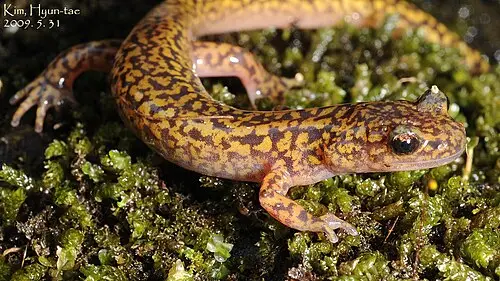
 📸 Photo
Photo: Kim, Hyun-tae · CC BY 4.0 · Wikimedia Commons Source
Korean Clawed Salamander
Onychodactylus koreanus (Korean Clawed Salamander · Korean Clawed Salamander)
💡 Everyday Comparisons for Size, Mass & Speed
- 💡 Climate modeling research projects that between 2050 and 2070 its suitable habitat area could shrink by up to 90.1% and its optimal habitat by 98.0%, leaving the central ridge of the Baekdudaegan as its last refuge.
- 💡 Because clear, cold mountain streams along the Baekdudaegan range—such as those in Hongcheon and Yanggu, Gangwon-do—are home to this salamander, the valleys encountered on mountain hikes are its actual habitat (PMC paper figure caption).
Reference standards: coach bus ~12 m, mid-size car ~4.9 m, compact car ~1 t, basketball hoop 3.05 m, credit card 8.56 cm.
📖 1. Overview
The Korean Clawed Salamander is a salamander living only near clear, cold mountain valleys on the Korean Peninsula, making it a narrow-range 'habitat specialist.' It is listed as Least Concern (LC, 2023 assessment) on the IUCN Red List.
🦴 2. Anatomy & Morphology
The Nakdonggang National Institute of Biological Resources introduces it as hunting prey mainly by sight, relying less on color vision and responding to the movement of receding prey. No body length or weight figures were found in the official sources consulted.
🔍 3. Ecology & Behavior
Living in mountain valleys and the adjacent forest, it has a long aquatic larval period and depends heavily on clear, cold water. Secretive in its habits, it is active for only about 5 hours a day and moves no more than 280 m in a year.
🇰🇷 4. Connection to Korea
It is listed as 'Hanguk-kkorichire-dorongnyong' (Korean name) on the National List of Species of Korea, and research papers describe mountain streams in Hongcheon and Yanggu in Gangwon-do as typical habitats for this species.
📚 Sources & References
- • IUCN Red List LC (2023) — https://www.iucnredlist.org/species/79098997/110101876
- • IUCN Red List category LC — latest assessment at iucnredlist.org
- • catalogueoflife.org — 49R6F
- • iucnredlist.org — 110101876
- • 국가생물종목록(국립생물자원관) ktsn 120000164706 — https://species.nibr.go.kr/home/mainHome.do?cont_link=009&subMenu=009002&contCd=009002&ktsn=120000164706
- • wikidata.org — Q3352852
- • pmc.ncbi.nlm.nih.gov — PMC8571601
- • artsandculture.google.com — GgFfSatztqb-mw
- • Silhouette: PhyloPic — zoosnow · CC0 1.0 (Congeneric silhouette — Onychodactylus fischeri)
Recorded dimensions are widely cited representative estimates from public literature and may vary by study or specimen.