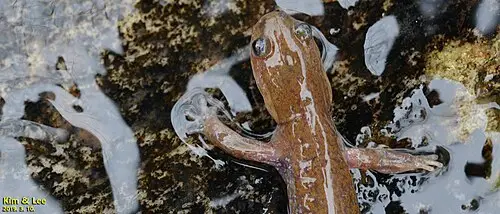
 📸 Photo
Photo: Kim, Hyun-tae · CC BY 4.0 · Wikimedia Commons Source
Cheju Salamander
Hynobius quelpaertensis (Cheju Salamander · サイシュウサンショウウオ)
💡 Everyday Comparisons for Size, Mass & Speed
- 💡 Because it is a Korean endemic salamander living not only on Jeju Island but also along the western and southern coasts and nearby islands, it can be encountered in mountain valleys and pools near the coast (National List of Species of Korea).
- 💡 It follows a seasonal rhythm of attaching banana-shaped egg masses in pools in spring (March–April) and hibernating under stones and fallen leaves in autumn (mid-October) (National List of Species of Korea).
Reference standards: coach bus ~12 m, mid-size car ~4.9 m, compact car ~1 t, basketball hoop 3.05 m, credit card 8.56 cm.
📖 1. Overview
The Cheju Salamander is an endemic species found only in Korea, confirmed not only on Jeju Island but also along the western and southern coasts and nearby islands. It is listed as Vulnerable (VU, 2019 assessment) on the IUCN Red List.
🦴 2. Anatomy & Morphology
Its trunk has sparse round dark-brown spots on a brown background, and males have a black back, thick forelegs, and a projection above the vent during the breeding season. It resembles the Korean Salamander, but has 37–42 shovel-shaped vomerine teeth on the palate compared with 31–36 in the Korean Salamander.
🔍 3. Ecology & Behavior
From March to April it breeds around lowland pools or streams, attaching banana-shaped egg masses to stones or branches, and preys mainly at night on small invertebrates such as insects and spiders. Around mid-October it enters hibernation under stones, leaves, and fallen old trees.
🇰🇷 4. Connection to Korea
An endemic species of Korea, it was originally thought to live only on Jeju Island, but surveys have confirmed its distribution along the western and southern coasts, some islands, southwestern Jeolla-do, and the Hamyang area of Gyeongsangnam-do (National List of Species of Korea).
📚 Sources & References
- • IUCN Red List VU (2019) — https://www.iucnredlist.org/species/119242042/110101600
- • IUCN Red List category VU — latest assessment at iucnredlist.org
- • catalogueoflife.org — 6N2KV
- • iucnredlist.org — 110101600
- • 국가생물종목록(국립생물자원관) ktsn 120000001360 — https://species.nibr.go.kr/home/mainHome.do?cont_link=009&subMenu=009002&contCd=009002&ktsn=120000001360
- • wikidata.org — Q3022201
- • species.nibr.go.kr — mainHome.do
- • Silhouette: PhyloPic — zoosnow · CC0 1.0 (Related taxon silhouette — Onychodactylus fischeri)
Recorded dimensions are widely cited representative estimates from public literature and may vary by study or specimen.