 📸 Photo
Photo: Kim, Hyun-tae · CC BY 4.0 · Wikimedia Commons Source
Korean Salamander
Hynobius leechii (Korean Salamander · チョウセンサンショウウオ)
💡 Everyday Comparisons for Size, Mass & Speed
- 💡 The male body length of 12 cm is about 1.4 times the long side of a credit card (85.6 mm) (Comparison).
- 💡 From March to May, a pair of banana-shaped egg sacs can be seen in foothill paddy banks or valley wetlands, with the eggs wrapped in three layers of transparent jelly (National List of Species of Korea).
Reference standards: coach bus ~12 m, mid-size car ~4.9 m, compact car ~1 t, basketball hoop 3.05 m, credit card 8.56 cm.
📖 1. Overview
The Korean Salamander is a caudate amphibian living along mountain valleys and moist rocks across almost all of Korea except Jeju Island. It is assessed as Least Concern (LC, 2023 assessment) on the IUCN Red List.
🦴 2. Anatomy & Morphology
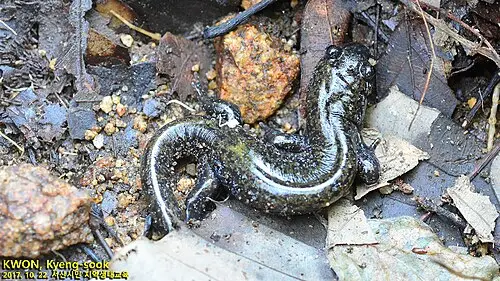
Males are larger than females, with males measuring 8–12 cm in body length and females 7–9 cm. Round dark brown spots are scattered over a brown background, the head is flat, the eyes are prominent, and the tip of the snout is rounded.
🔍 3. Ecology & Behavior
From March to May it lays eggs in mountain rice-paddy banks or stream wetlands; a pair of egg sacs contains about 100 eggs that hatch within 3–4 weeks. Larvae breathe with external gills when young and breathe with lungs after metamorphosis.
🇰🇷 4. Connection to Korea
It is listed on the National List of Species of Korea as distributed across the mainland and islands nationwide except Jeju Island, and globally it also occurs in northeastern China.
📚 Sources & References
- • IUCN Red List LC (2023) — https://www.iucnredlist.org/species/201035128/201035971
- • IUCN Red List category LC — latest assessment at iucnredlist.org
- • catalogueoflife.org — 3NLTW
- • iucnredlist.org — 201035971
- • 국가생물종목록(국립생물자원관) ktsn 120000001359 — https://species.nibr.go.kr/home/mainHome.do?cont_link=009&subMenu=009002&contCd=009002&ktsn=120000001359
- • wikidata.org — Q1065311
- • species.nibr.go.kr — mainHome.do
- • Silhouette: PhyloPic — zoosnow · CC0 1.0 (Related taxon silhouette — Onychodactylus fischeri)
Recorded dimensions are widely cited representative estimates from public literature and may vary by study or specimen.