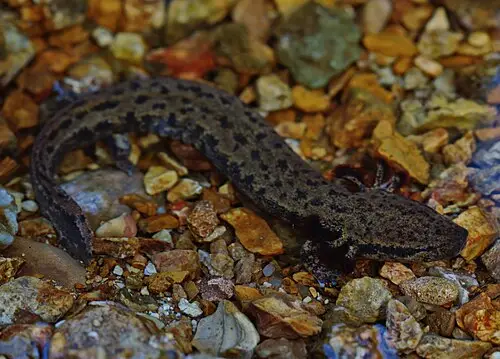
 📸 Photo
Photo: Peter Paplanus · CC BY 2.0 · Wikimedia Commons Source
Mudpuppy
Necturus maculosus (Mudpuppy · Mudpuppy)
💡 Everyday Comparisons for Size, Mass & Speed
- 💡 Its body length of 33 cm is 3 cm longer than a 30 cm ruler (Comparison).
- 💡 Because it even eats carrion, it is often caught in traps baited with dead fish (ADW).
- 💡 It is also occasionally collected for research and educational purposes (ADW, 'Positive Impacts').
Reference standards: coach bus ~12 m, mid-size car ~4.9 m, compact car ~1 t, basketball hoop 3.05 m, credit card 8.56 cm.
📖 1. Overview
The Mudpuppy is a large North American salamander that lives in water its entire life, retaining its juvenile red external gills even as an adult. It is assessed as Least Concern (LC, 2023 assessment) on the IUCN Red List.
🦴 2. Anatomy & Morphology
Measuring 20–33 cm in body length, it keeps maroon external gills throughout life, with individuals in cold, oxygen-rich water having shorter gills. Its body is gray or rusty brown to black with dark spots and a whitish belly.
🔍 3. Ecology & Behavior
It hides under logs, rocks, and aquatic weeds by day and opportunistically feeds at night on crayfish, insect larvae, small fish, fish eggs, snails, other amphibians, and even carrion. Active year-round without hibernating, it gathers in shallow water in autumn to mate, and females store sperm in their bodies until spring.
🇰🇷 4. Connection to Korea
No direct record connecting this species to Korea has been found.
📚 Sources & References
- • IUCN Red List LC (2023) — https://www.iucnredlist.org/species/88373148/199271045
- • IUCN Red List category LC — latest assessment at iucnredlist.org
- • catalogueoflife.org — 463VD
- • iucnredlist.org — 199271045
- • wikidata.org — Q604445
- • commons.wikimedia.org — File:Gefleckter Furchenmolch (Necturus maculosus), Seitenans
- • animaldiversity.org — Necturus maculosus
- • Silhouette: PhyloPic — Jose Carlos Arenas-Monroy · CC0 1.0 (Related taxon silhouette — Proteus anguinus)
Recorded dimensions are widely cited representative estimates from public literature and may vary by study or specimen.