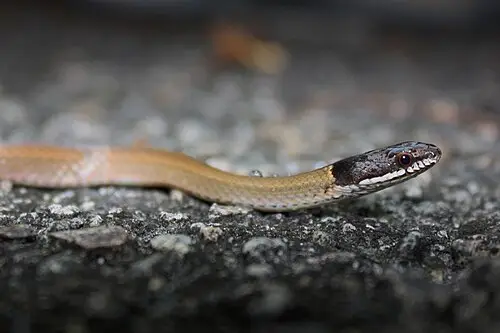
 📸 Photo
Photo: Thomas Brown · CC BY 2.0 · Wikimedia Commons Source
Chinese Many-tooth Snake
Sibynophis chinensis (Chinese Many-tooth Snake · Chinese Many-tooth Snake)
🇰🇷 Class I endangered wildlife (Korea)
💡 Everyday Comparisons for Size, Mass & Speed
- 💡 A total length of 61 cm is about the length of two 30 cm student rulers placed end to end (Comparison).
- 💡 Newly hatched young weigh about 1.66 g, which is about 1/3 the weight of a Korean 100-won coin (5.42 g) (Comparison).
Reference standards: coach bus ~12 m, mid-size car ~4.9 m, compact car ~1 t, basketball hoop 3.05 m, credit card 8.56 cm.
📖 1. Overview
The Chinese Many-tooth Snake is a small snake living in southern China, Taiwan, and Vietnam; in Korea, it is a Class I endangered snake with a breeding record from Jeju Island.
🦴 2. Anatomy & Morphology
Its back is grayish brown with a black line running down the middle of the forebody, and its head is spoon-shaped and nearly black. Its scales are smooth, and it may have a thin white collar on the neck.
🔍 3. Ecology & Behavior
Active by day, it mainly swallows lizards (skinks) whole, headfirst. It lays eggs; a female caught on Jeju Island laid 6 eggs, of which 5 hatched in 34–41 days, and the newly hatched young measured about 136.5 mm in snout-vent length.
🇰🇷 4. Connection to Korea
In Korea, it is designated as Class I endangered wildlife (Korea). The first domestic breeding record came in 2018 from a female captured in the Mulyeongari-oreum Wetland Protected Area on Jeju Island.
📚 Sources & References
- • IUCN Red List LC (2014) — https://www.iucnredlist.org/species/193454/2237835
- • 멸종위기 야생생물 Ⅰ급 — 국가생물종목록(국립생물자원관) ktsn 120000059495 — https://species.nibr.go.kr/home/mainHome.do?cont_link=009&subMenu=009002&contCd=009002&ktsn=120000059495
- • IUCN Red List category LC — latest assessment at iucnredlist.org
- • Korean protection status: Class I endangered wildlife (Korea)
- • catalogueoflife.org — 6YLFC
- • iucnredlist.org — 2237835
- • 국가생물종목록(국립생물자원관) ktsn 120000059495 — https://species.nibr.go.kr/home/mainHome.do?cont_link=009&subMenu=009002&contCd=009002&ktsn=120000059495
- • wikidata.org — Q3061115
- • commons.wikimedia.org — File:Chinese Mountain Snake (Sibynophis chinensis) 黑頭劍蛇4.jpg
- • biosch.hku.hk — Sibynophis chinensis chinensis.html
- • reptile-database.reptarium.cz — species
- • accesson.kr — 7168
- • species.nibr.go.kr — general-search
- • Silhouette: PhyloPic — Alex Slavenko · CC0 1.0 (Related taxon silhouette — Elaphe quatuorlineata)
Recorded dimensions are widely cited representative estimates from public literature and may vary by study or specimen.