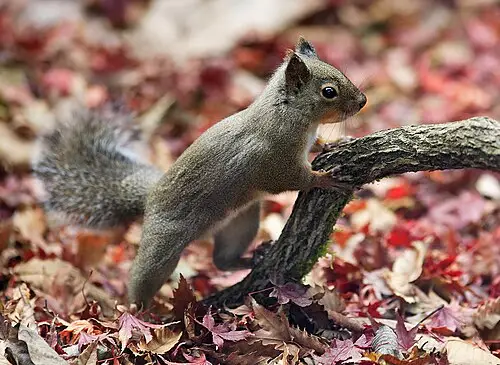
 📸 Photo
Photo: Ma2bara · Public domain · Wikimedia Commons Source
Japanese Squirrel
Sciurus lis (Japanese Squirrel · ニホンリス)
💡 Everyday Comparisons for Size, Mass & Speed
- 💡 The maximum distance of 168 m it carries walnuts to bury them is 1.6 times the length of a soccer field (about 105 m) (Comparison). Its maximum weight of 310 g is about five chicken eggs (around 60 g each) (Comparison).
- 💡 For Japanese Squirrels in Karuizawa, Nagano Prefecture, Japanese walnuts make up about 35% of their annual diet.
Reference standards: coach bus ~12 m, mid-size car ~4.9 m, compact car ~1 t, basketball hoop 3.05 m, credit card 8.56 cm.
Site-computed relative index from recorded values; not a formal scientific metric.
📖 1. Overview
The Japanese Squirrel is a diurnal tree squirrel living in the forests of Japan, favoring lowland mixed forests and subalpine pinewoods.
🦴 2. Anatomy & Morphology
Its back is mostly brown and its belly white, sometimes with orange tints on the shoulders and flanks. In winter the back and tail turn grayer, and it has large eyes and ears.
🔍 3. Ecology & Behavior
It feeds mainly on seeds, buds, flowers, and fruits, and also eats insects and fungi. It buries Japanese walnuts in the ground for storage; in one study it buried 50.6% of 720 walnuts and carried them up to 168 m away.
🇰🇷 4. Connection to Korea
No direct record connecting this species to Korea has been found.
📚 Sources & References
- • IUCN Red List LC (2016) — https://www.iucnredlist.org/species/20014/115155004
- • IUCN Red List category LC — latest assessment at iucnredlist.org
- • mammaldiversity.org — 1001689
- • iucnredlist.org — 115155004
- • wikidata.org — Q838575
- • commons.wikimedia.org — File:Japanese Squirrel edit2.jpg
- • animaldiversity.org — Sciurus lis
- • Silhouette: PhyloPic — Ferran Sayol · CC0 1.0 (Congeneric silhouette — Sciurus vulgaris)
Recorded dimensions are widely cited representative estimates from public literature and may vary by study or specimen.