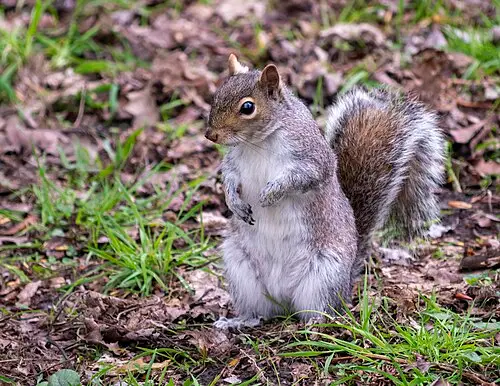
 📸 Photo
Photo: Dominic Nelson · CC BY-SA 4.0 · Wikimedia Commons Source
Eastern Gray Squirrel
Sciurus carolinensis (Eastern Gray Squirrel · トウブハイイロリス)
💡 Everyday Comparisons for Size, Mass & Speed
- 💡 Its maximum weight of 750 g equals one and a half 500 mL water bottles (about 0.5 kg each), and its total length of 52.5 cm is about 1.8 times the long side of an A4 sheet (29.7 cm) (Comparison).
- 💡 In the U.S. state of Mississippi, 2.5 million are hunted each year for an economic impact of 12.5 million dollars, and nature watchers rank them second only to birds in value.
Reference standards: coach bus ~12 m, mid-size car ~4.9 m, compact car ~1 t, basketball hoop 3.05 m, credit card 8.56 cm.
Site-computed relative index from recorded values; not a formal scientific metric.
📖 1. Overview
The Eastern Gray Squirrel is a medium-sized tree squirrel of eastern North American forests that also thrives in cities and suburbs.
🦴 2. Anatomy & Morphology
Its back ranges from dark to pale gray, sometimes mixed with cinnamon tones, while its ears and tail are pale gray to white. Males and females do not differ in size or color, and black individuals are common in the north.
🔍 3. Ecology & Behavior
It feeds mainly on nuts, flowers, and buds of trees such as oaks, hickories, and walnuts, along with grains, fungi, and insects. Most active in the morning and before sunset, it uses both tree cavities and leaf nests built on branches.
🇰🇷 4. Connection to Korea
No direct record connecting this species to Korea has been found.
📚 Sources & References
- • IUCN Red List LC (2018) — https://www.iucnredlist.org/species/42462/276917738
- • IUCN Red List category LC — latest assessment at iucnredlist.org
- • mammaldiversity.org — 1001680
- • iucnredlist.org — 276917738
- • wikidata.org — Q468500
- • commons.wikimedia.org — File:Grey squirrel standing, Bute Park, Cardiff.jpg
- • animaldiversity.org — Sciurus carolinensis
- • Silhouette: PhyloPic — Andy Wilson · CC0 1.0
Recorded dimensions are widely cited representative estimates from public literature and may vary by study or specimen.