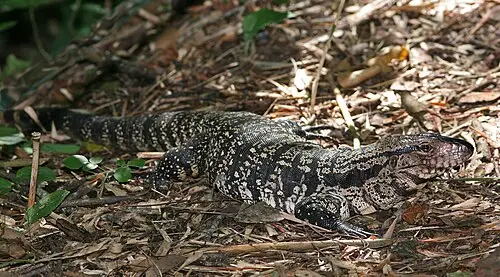
 📸 Photo
Photo: Tomfriedel · CC BY 3.0 · Wikimedia Commons Source
Argentine Black and White Tegu
Salvator merianae (Argentine Black and White Tegu · ミナミテグー)
💡 Everyday Comparisons for Size, Mass & Speed
- 💡 A maximum total length of 1.6 m is just shy of an adult human's height (about 1.7 m), and a weight of 5 kg is equal to a 5 kg bag of rice (Comparison).
- 💡 Popular in the international pet trade, it was brought to the United States and spread as an invasive species in Florida (a 2025 paper on the Florida population).
Reference standards: coach bus ~12 m, mid-size car ~4.9 m, compact car ~1 t, basketball hoop 3.05 m, credit card 8.56 cm.
Site-computed relative index from recorded values; not a formal scientific metric.
📖 1. Overview
The Argentine Black and White Tegu is a large teiid lizard living in South America, distributed in Argentina, Brazil, Paraguay, Uruguay, and Bolivia, and is an introduced species in Florida.
🦴 2. Anatomy & Morphology
When fully grown, it is a large lizard reaching 1.6 m in total length and 5 kg in weight.
🔍 3. Ecology & Behavior
It is an omnivore that eats fruit, flowers, fungi, invertebrates, small vertebrates, carrion, and eggs. Juveniles mainly eat insects, spiders, snails, and soft fruit.
🇰🇷 4. Connection to Korea
No direct record connecting this species to Korea has been found.
📚 Sources & References
- • IUCN Red List LC (2016) — https://www.iucnredlist.org/species/178340/61322552
- • IUCN Red List category LC — latest assessment at iucnredlist.org
- • catalogueoflife.org — 6XFSD
- • iucnredlist.org — 61322552
- • wikidata.org — Q24354290
- • commons.wikimedia.org — File:Black and White Tegu.jpg
- • journals.ku.edu — 94879
- • reptile-database.reptarium.cz — species
- • Silhouette: PhyloPic — Gopal Murali · CC0 1.0 (Related taxon silhouette — Aspidoscelis sonorae)
Recorded dimensions are widely cited representative estimates from public literature and may vary by study or specimen.