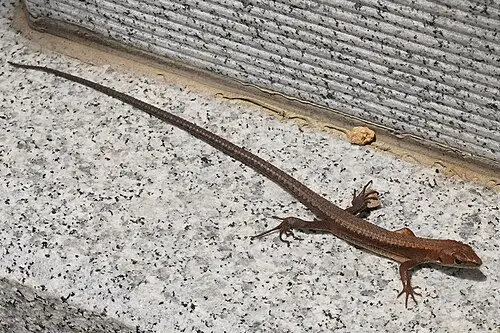
 📸 Photo
Photo: 들꽃ㅅr랑 (bsmouse) · CC0 · Wikimedia Commons Source
Amur Grass Lizard
Takydromus amurensis (Amur Grass Lizard · アムールカナヘビ)
💡 Everyday Comparisons for Size, Mass & Speed
- 💡 A male's maximum tail length of 15 cm is slightly longer than a ballpoint pen (about 14 cm) (Comparison).
- 💡 Domestic surveys confirmed that males have longer tails and heads than females, providing a clue when telling the sexes of grass lizards apart.
Reference standards: coach bus ~12 m, mid-size car ~4.9 m, compact car ~1 t, basketball hoop 3.05 m, credit card 8.56 cm.
📖 1. Overview
The Amur Grass Lizard is a slender, very long-tailed small lizard living in the Russian Primorye, northeastern China, Korea, and Tsushima Island.
🦴 2. Anatomy & Morphology
Its torso measures 40–65 mm, while the male's tail reaches 101–151 mm, about two and a half times the torso length. Males have longer tails and heads than females.
🔍 3. Ecology & Behavior
It belongs to the group of small diurnal lizards that eat insects and spiders. It lays eggs.
🇰🇷 4. Connection to Korea
It is one of the 3 grass lizard species living in Korea (Mongolia Racerunner, Amur Grass Lizard, and Jangjibaem (a Korean animal name)). A table in one study lists 673 confirmed domestic localities.
📚 Sources & References
- • IUCN Red List LC (2022) — https://www.iucnredlist.org/species/47755997/222698178
- • IUCN Red List category LC — latest assessment at iucnredlist.org
- • catalogueoflife.org — 54KR9
- • iucnredlist.org — 222698178
- • 국가생물종목록(국립생물자원관) ktsn 120000059475 — https://species.nibr.go.kr/home/mainHome.do?cont_link=009&subMenu=009002&contCd=009002&ktsn=120000059475
- • wikidata.org — Q5083943
- • commons.wikimedia.org — File:Takydromus amurensis from iNaturalist photo 525905654.j
- • koreascience.or.kr — JAKO201203939214848.pdf
- • reptile-database.reptarium.cz — species
- • pmc.ncbi.nlm.nih.gov — PMC9436999
- • pmc.ncbi.nlm.nih.gov — PMC9816106
- • species.nibr.go.kr — general-search
- • Silhouette: PhyloPic — Gustav Mützel · Public Domain Mark 1.0 (Related taxon silhouette — Lacerta agilis)
Recorded dimensions are widely cited representative estimates from public literature and may vary by study or specimen.