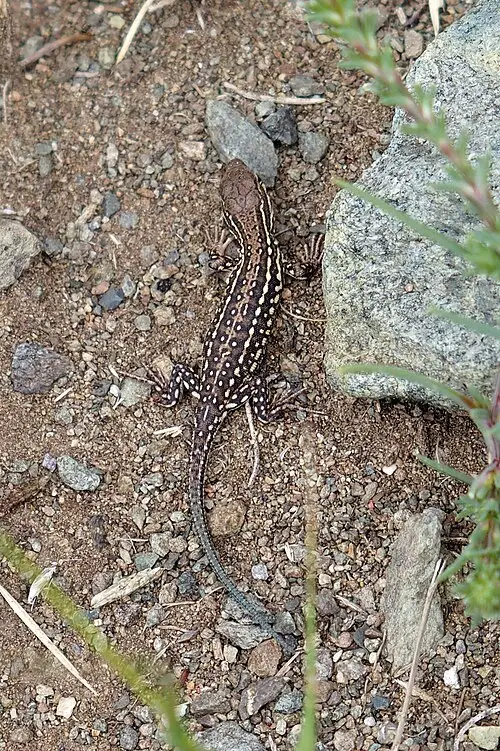
 📸 Photo
Photo: Haplochromis · CC BY-SA 4.0 · Wikimedia Commons Source
Mongolia Racerunner
Eremias argus (Mongolia Racerunner · Mongolia Racerunner)
🇰🇷 Class II endangered wildlife (Korea)
💡 Everyday Comparisons for Size, Mass & Speed
- 💡 A body length of 6.4 cm is about two and a half times the diameter of a Korean 500-won coin (2.65 cm) (Comparison).
- 💡 In a study at Taeanhaean National Park, stomach contents consisted of insects, spiders, and amphipods across 8 orders and 13 families—a lizard living on small prey in coastal sandy ground.
Reference standards: coach bus ~12 m, mid-size car ~4.9 m, compact car ~1 t, basketball hoop 3.05 m, credit card 8.56 cm.
📖 1. Overview
The Mongolia Racerunner is a small lacertid lizard living in Mongolia, northeastern China, southern Russia, and along the west coast of Korea.
🦴 2. Anatomy & Morphology
Its body (snout-to-vent length) is small at 31–64 mm. Males have longer tails and heads as well as longer forelimbs and hindlimbs than females.
🔍 3. Ecology & Behavior
Active by day, it eats insects and spiders. In the stomachs of 6 individuals caught in Taeanhaean National Park, lepidopteran insects (30.6%) and spiders (20.4%) were most abundant, and the species lays eggs.
🇰🇷 4. Connection to Korea
In Korea, it is designated as Class II endangered wildlife (Korea) and has been recorded in west-coast coastal sand dunes (such as Taean) and some mountain areas. Only 3 lacertid species live in Korea: the Mongolia Racerunner, the Amur Grass Lizard, and Jangjibaem (a Korean animal name).
📚 Sources & References
- • IUCN Red List LC (2019) — https://www.iucnredlist.org/species/47755847/47755852
- • 멸종위기 야생생물 Ⅱ급 — 국가생물종목록(국립생물자원관) ktsn 120000059473 — https://species.nibr.go.kr/home/mainHome.do?cont_link=009&subMenu=009002&contCd=009002&ktsn=120000059473
- • IUCN Red List category LC — latest assessment at iucnredlist.org
- • Korean protection status: Class II endangered wildlife (Korea)
- • catalogueoflife.org — 6GDVC
- • iucnredlist.org — 47755852
- • 국가생물종목록(국립생물자원관) ktsn 120000059473 — https://species.nibr.go.kr/home/mainHome.do?cont_link=009&subMenu=009002&contCd=009002&ktsn=120000059473
- • wikidata.org — Q5077948
- • commons.wikimedia.org — File:Eremias argus.JPG
- • koreascience.or.kr — JAKO201203939214848.pdf
- • earticle.net — A181332
- • earticle.net — A188095
- • reptile-database.reptarium.cz — species
- • pmc.ncbi.nlm.nih.gov — PMC9436999
- • species.nibr.go.kr — general-search
- • Silhouette: PhyloPic — Gustav Mützel · Public Domain Mark 1.0 (Related taxon silhouette — Lacerta agilis)
Recorded dimensions are widely cited representative estimates from public literature and may vary by study or specimen.