 📸 Photo
Photo: Lovelove · CC BY-SA 3.0 · Wikimedia Commons Source
Mountain Grass Lizard
Takydromus wolteri (Mountain Grass Lizard · Mountain Grass Lizard)
💡 Everyday Comparisons for Size, Mass & Speed
- 💡 A body length of about 46 mm is slightly shorter than the short side of a credit card (about 54 mm), though it is much longer when the tail is included (Comparison).
- 💡 It can be seen in grasslands and along rivers nationwide, especially in the grasslands of Jeju Island (domestic distribution in the National List of Species of Korea). It basks in sunny spots during the day and hides in thickets when people approach.
Reference standards: coach bus ~12 m, mid-size car ~4.9 m, compact car ~1 t, basketball hoop 3.05 m, credit card 8.56 cm.
📖 1. Overview
The Mountain Grass Lizard is a small lizard seen in grasslands and along rivers throughout Korea, with a tail much longer than its body.
🦴 2. Anatomy & Morphology
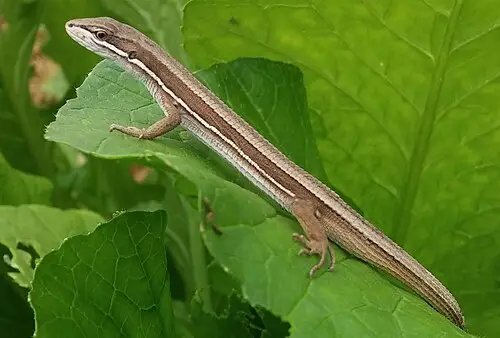
Its body length is about 46 mm and its tail is about 2.5 times its body length. It has a pointed snout, a white line along each side of its greenish-brown body, and a yellowish-white or greenish-white belly.
🔍 3. Ecology & Behavior
It wakes from hibernation around month 4 to bask in the sun and eats small terrestrial insects such as spiders and crickets. In months 6–8 it lays usually 4–5 white eggs in grassy bushes or rock crevices, and hides in thickets or burrows when threatened.
🇰🇷 4. Connection to Korea
According to the National List of Species of Korea, it is distributed nationwide, with especially large numbers living on Jeju Island where grasslands are extensive. In central Korea, most individuals enter hibernation in underground burrows by mid-month 10.
📚 Sources & References
- • IUCN Red List LC (2022) — https://www.iucnredlist.org/species/47756012/214715587
- • IUCN Red List category LC — latest assessment at iucnredlist.org
- • catalogueoflife.org — 54KS8
- • iucnredlist.org — 214715587
- • 국가생물종목록(국립생물자원관) ktsn 120000059476 — https://species.nibr.go.kr/home/mainHome.do?cont_link=009&subMenu=009002&contCd=009002&ktsn=120000059476
- • wikidata.org — Q5090735
- • commons.wikimedia.org — File:줄장지뱀.jpg
- • species.nibr.go.kr — mainHome.do
- • Silhouette: PhyloPic — Gustav Mützel · Public Domain Mark 1.0 (Related taxon silhouette — Lacerta agilis)
Recorded dimensions are widely cited representative estimates from public literature and may vary by study or specimen.