 📸 Photo
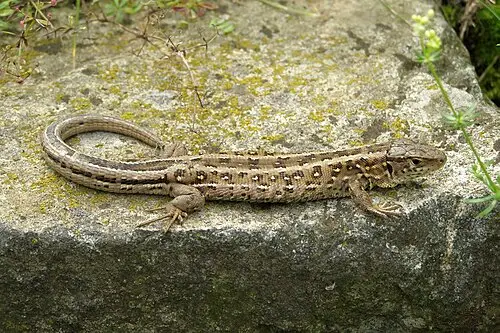
Photo: Krzysztof Mizera · CC BY-SA 3.0 · Wikimedia Commons Source
Sand Lizard
Lacerta agilis (Sand Lizard · ニワカナヘビ)
💡 Everyday Comparisons for Size, Mass & Speed
- 💡 A snout-to-vent length of 17.5 cm is about twice the long side of a credit card (about 8.6 cm) (Comparison).
- 💡 In the United Kingdom it is strictly protected by law, making it illegal to capture it or damage its habitat; native populations survive only on heathlands in Surrey, Dorset, and Hampshire and sand dunes in Merseyside, with other sites being reintroductions (Amphibian and Reptile Conservation Trust).
Reference standards: coach bus ~12 m, mid-size car ~4.9 m, compact car ~1 t, basketball hoop 3.05 m, credit card 8.56 cm.
📖 1. Overview
The Sand Lizard is a stocky lizard widely distributed from Europe to Central Asia, living in sandy heathlands and sand dunes.
🦴 2. Anatomy & Morphology
It has a relatively thick head and body, with two distinct stripes running down its brown back. Males have green flanks.
🔍 3. Ecology & Behavior
Oviparous, in the United Kingdom it emerges from hibernation in late March to April, buries its eggs in sunlit sand in late May to early June, and the young hatch in late August to September.
🇰🇷 4. Connection to Korea
No direct record connecting this species to Korea has been found.
📚 Sources & References
- • IUCN Red List LC (2021) — https://www.iucnredlist.org/species/157288/49644624
- • IUCN Red List category LC — latest assessment at iucnredlist.org
- • catalogueoflife.org — 6NRCH
- • iucnredlist.org — 49644624
- • wikidata.org — Q148595
- • commons.wikimedia.org — File:Jaszczurka.jpg
- • reptile-database.reptarium.cz — species
- • arc-trust.org — sand-lizard
- • Silhouette: PhyloPic — Gustav Mützel · Public Domain Mark 1.0
Recorded dimensions are widely cited representative estimates from public literature and may vary by study or specimen.