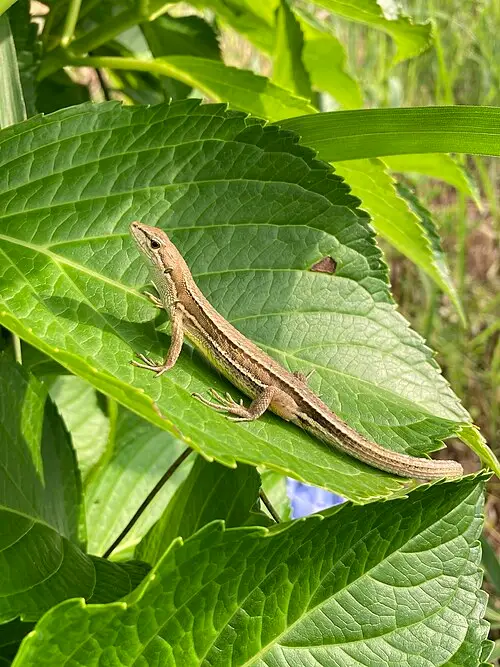
 📸 Photo
Photo: Norio Nomura · CC BY-SA 4.0 · Wikimedia Commons Source
Japanese Grass Lizard
Takydromus tachydromoides (Japanese Grass Lizard · ニホンカナヘビ)
💡 Everyday Comparisons for Size, Mass & Speed
- 💡 A total length of 27 cm is slightly shorter than a 30 cm ruler, and a weight of 8 g is similar to a Korean 500-won coin (about 7.7 g) (Comparison).
- 💡 Surveys of grasslands along the Tenryu River floodplain in Japan found it everywhere and in large numbers (under the 'Kanahebi' entry in survey materials from Japan's Ministry of Land, Infrastructure, Transport and Tourism).
Reference standards: coach bus ~12 m, mid-size car ~4.9 m, compact car ~1 t, basketball hoop 3.05 m, credit card 8.56 cm.
Site-computed relative index from recorded values; not a formal scientific metric.
📖 1. Overview
The Japanese Grass Lizard is a small, long-tailed lizard commonly seen in grasslands of the Japanese archipelago.
🦴 2. Anatomy & Morphology
Its head-and-body length is 50–70 mm, and its unusually long tail brings its total length to 160–270 mm. Weighing 2–8 g, it is very light.
🔍 3. Ecology & Behavior
Fond of grasslands, it lives among fallen leaves and grassy thickets without digging burrows of its own. It mainly eats insects and spiders, begins laying eggs in months 3–5 and lays multiple clutches of 2–6 eggs through early month 8, and its natural enemies include snakes, birds, and weasels.
🇰🇷 4. Connection to Korea
No direct record connecting this species to Korea has been found.
📚 Sources & References
- • IUCN Red List LC (2017) — https://www.iucnredlist.org/species/96266178/96266321
- • IUCN Red List category LC — latest assessment at iucnredlist.org
- • catalogueoflife.org — 54KS4
- • iucnredlist.org — 96266321
- • wikidata.org — Q615871
- • commons.wikimedia.org — File:Takydromus tachydromoides 212617777.jpg
- • cbr.mlit.go.jp — 009 07.pdf
- • reptile-database.reptarium.cz — species
- • Silhouette: PhyloPic — Gustav Mützel · Public Domain Mark 1.0 (Related taxon silhouette — Lacerta agilis)
Recorded dimensions are widely cited representative estimates from public literature and may vary by study or specimen.