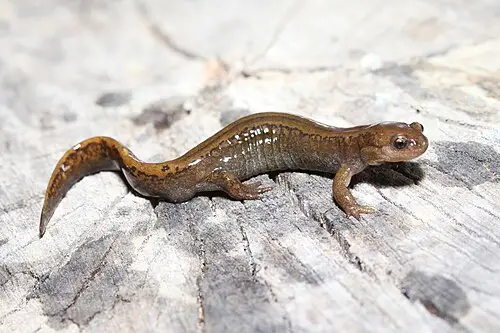
 📸 Photo
Photo: Svyatoslav Knyazev · CC BY 4.0 · Wikimedia Commons Source
Siberian Salamander
Salamandrella keyserlingii (Siberian Salamander · キタサンショウウオ)
💡 Everyday Comparisons for Size, Mass & Speed
- 💡 An egg sac holding 117–118 eggs contains about four times as many eggs as a standard tray of eggs (30 eggs) in Korea (Comparison).
- 💡 Its body length of 12.5 cm is about 1.5 times the long side of a credit card (85.6 mm) (Comparison).
Reference standards: coach bus ~12 m, mid-size car ~4.9 m, compact car ~1 t, basketball hoop 3.05 m, credit card 8.56 cm.
📖 1. Overview
The Siberian Salamander is a salamander widely distributed across Siberia, Mongolia, and the northern Korean Peninsula that breeds in standing water. It is listed as Least Concern (LC, 2023 assessment) on the IUCN Red List.
🦴 2. Anatomy & Morphology
Measuring 9–12.5 cm in body length, it has a bluish-brown body with an orange stripe running down the middle of the back from head to tail. Its head is flat and oval, its skin is smooth with well-developed glands, both front and hind feet have 4 toes each, and its tail is longer than its trunk.
🔍 3. Ecology & Behavior
From late April to early May it breeds in standing water, laying 117–118 eggs inside bluish-white transparent banana-shaped egg sacs—far more than other salamanders. Because the larvae have small mouths they do not cannibalize one another, metamorphosing and coming ashore in early August, while adults eat earthworms and insects.
🇰🇷 4. Connection to Korea
Although listed on the National List of Species of Korea, on the Korean Peninsula it has been recorded only in the highlands of northeastern North Korea. Abroad, it is widely distributed around Lake Baikal, Sakhalin, and Kamchatka.
📚 Sources & References
- • IUCN Red List LC (2023) — https://www.iucnredlist.org/species/136687833/63860072
- • IUCN Red List category LC — latest assessment at iucnredlist.org
- • catalogueoflife.org — 6XBLN
- • iucnredlist.org — 63860072
- • 국가생물종목록(국립생물자원관) ktsn 120000001365 — https://species.nibr.go.kr/home/mainHome.do?cont_link=009&subMenu=009002&contCd=009002&ktsn=120000001365
- • wikidata.org — Q1549384
- • commons.wikimedia.org — File:Salamandrella keyserlingii.jpg
- • species.nibr.go.kr — mainHome.do
- • Silhouette: PhyloPic — zoosnow · CC0 1.0 (Related taxon silhouette — Onychodactylus fischeri)
Recorded dimensions are widely cited representative estimates from public literature and may vary by study or specimen.